by Connor Sites-Bowen
The Pittsburgh Botanic Garden is the city’s OTHER formal garden space. Out from under the central, urban shadow of the storie, Victorian Phipps Conservatory, the PBG is a modern, scrappy organization, with a much better story to tell. They never had an endowment, they started with a superfund site.
I started visiting the Botanic Garden back during the COVID 19 pandemic, when it was one of the few local institutions which remained able-to-be-open-without-much-change during the lockdown years. A dual membership allows you to randomly bring a friend (or a date!) along to the Garden with very little hassle and no additional ticket cost.
The Botanic Garden sits in the bottom quarter of Settler’s Cabin Park, itself in the western suburbs, on the way to the airport. It is not easy to walk to. For decades during and between the world wars, the woods here were the site of wanton surface mining. Coal seams broke free from deep earthly currents here, and material could be gathered and sold directly into the steelmaking process. This is the kind of forest-based surface mining which the Seven Dwarves engaged in, in the stories. Countless shallow mines were constructed, and few were properly shut down. By the 1960s, it was clear what these reckless decades had done: the surrounding streams ran green, white-blue, red, and other unnatural colors, because the mines had never been put to bed properly, and had become leeching pools for heavy metals every time it rained.
In the 90s, an enormous effort was made to properly implode the mines, to establish draining pumps, and to keep the leeching from continuing. Now, the Pittsburgh Botanic Gardens sit as a cap of soil atop all of that re-engineering. The groves, the meadow, every garden grows atop managed destruction. When you visit the site, you will still find subtle signs of the reuse and restoration. The small creek which feeds the formal pond leads down to a second pond, where aluminum hydroxide falls out of the mine drainage, turning the bottom of that pond blue-white. After our mining efforts, and before the Botanic Garden, this land used to leak those poisons directly into the tributaries of the Ohio River. No more!
In addition to the native plants, rewilding meadow, five senses garden, and formal lake, the Botanic Gardens hold the Carbon Cycle, a long-running sculptural grove, with ritually burned coal and trees, encircled by a ring of new trees, now a decade old. Their visitor center hosts a revolving Artist in Residence and their art. They also book a rotation of outdoor sculptures which grace the garden for a season or two at a time.
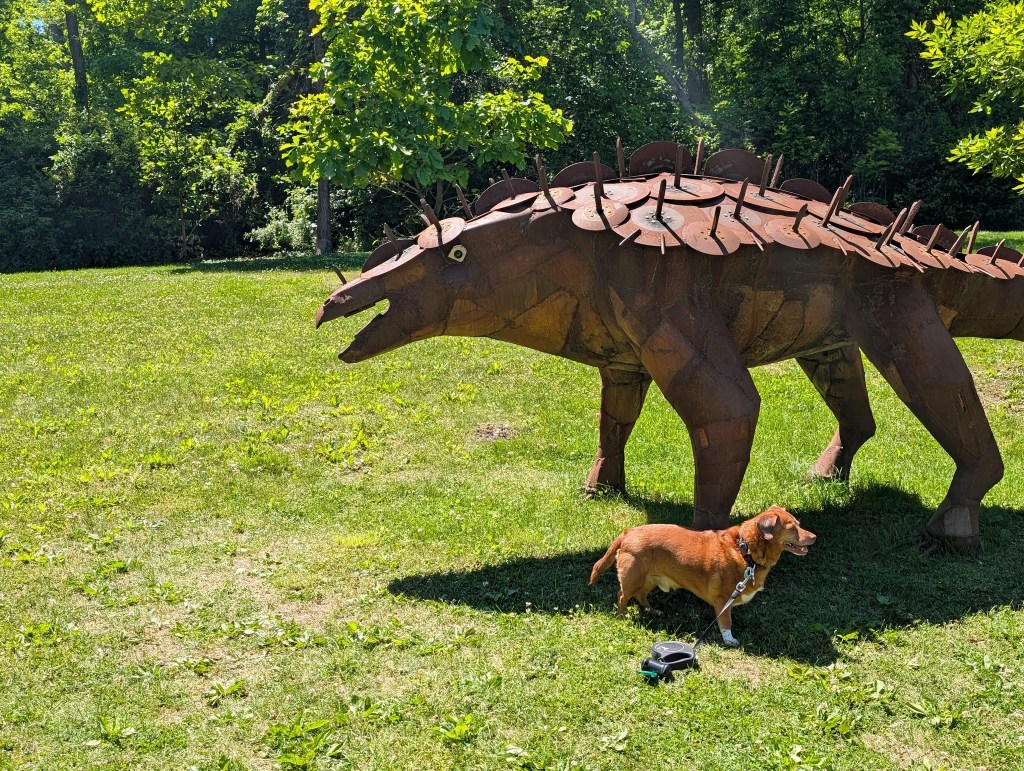
I recently took my little studio dog Tucker Davis (he’s from Johnstown, so they gave him a full country name) on a visit to see the current exhibits and plants. I think he had fun!
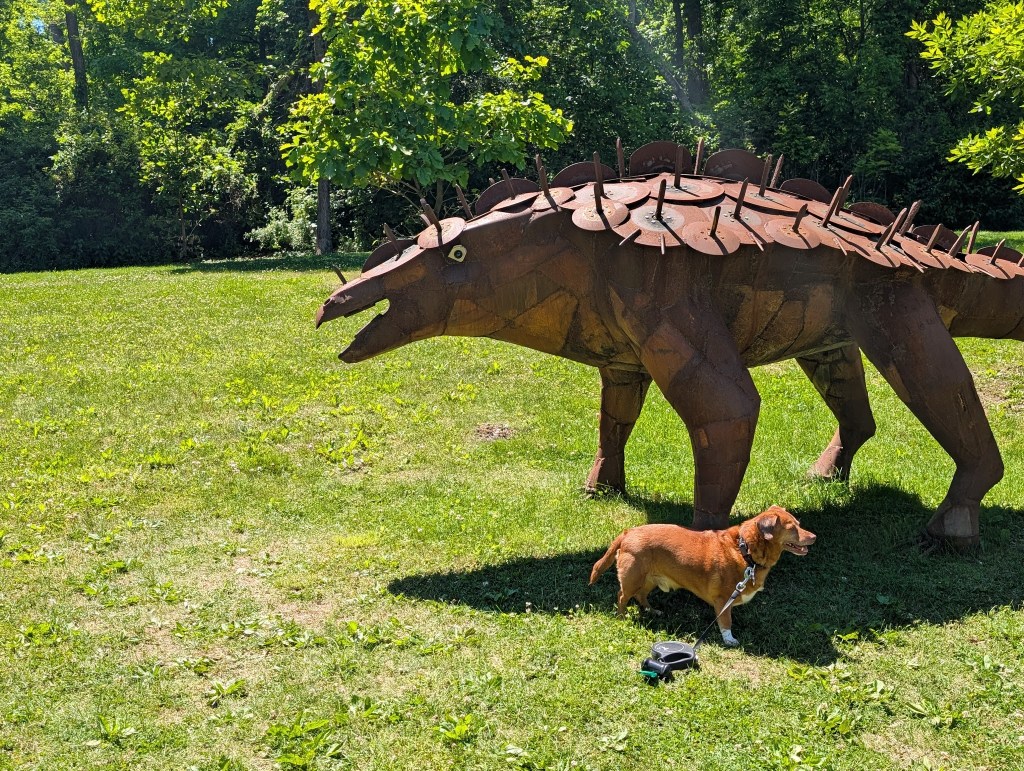
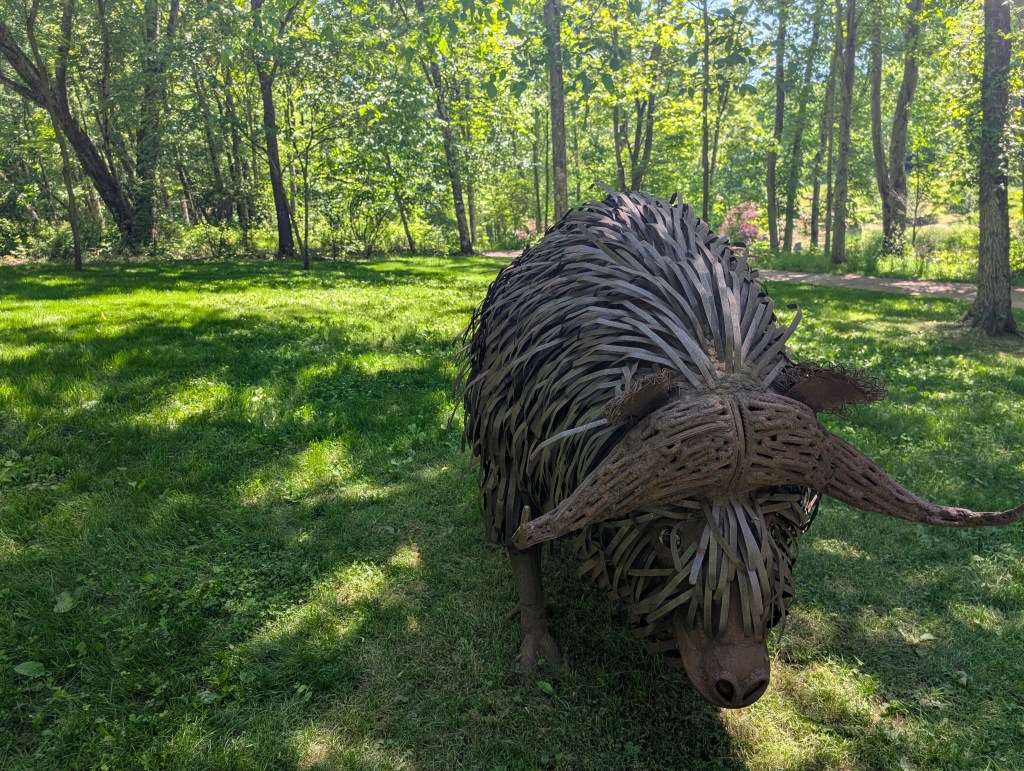
The Scraposaurs are an impressive and heavy bunch, each its own study in reused metal materials. They drip with Americana – this is some of the most straightforwardly big and bold sculpture you can ask for, in subject choice and in material effort. The sculptural subjects are not strictly dinosaurs – there are musk oxen, a sabretooth cat, a pterodactyl, and other lost species, rendered bold and strong among the Locust, Silver Oak, Sycamore, and Black Cherry trees.
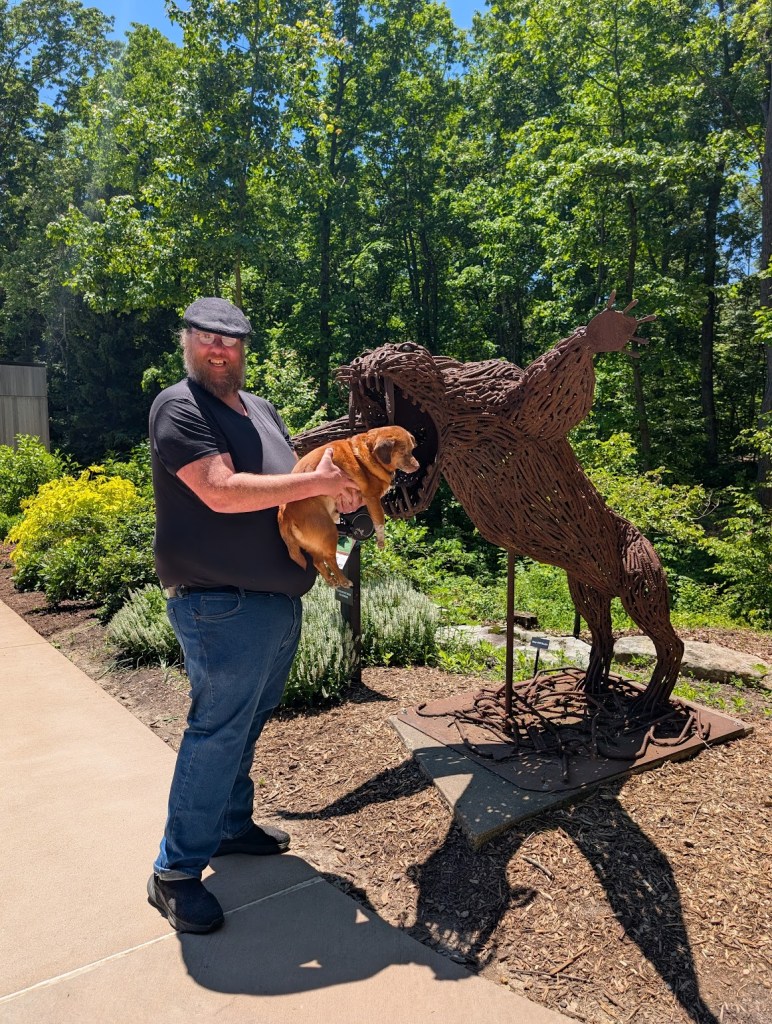
Scraposaurs sees 15 recycled-material sculptures, each of them by Minnesota artist Dale Lewis, which will be in the Garden through October 31. Of the material choice, Lewis has said “I discovered that metal provides greater flexibility [than mosaic] and working with scrap offers a wide variety of materials that often influence the design of my work. Not only can my pieces be permanently installed outdoors, but I love turning scrap into art. I look at things differently now, especially at junk yards and see art everywhere!”
The mosaic of Western Pennsylvania ecosystems that compose the park are a mysterious and delightful mansion of green rooms, and the scraposaur sculptures fill those woods out with mythical, magical, historical beasts. What a treat!
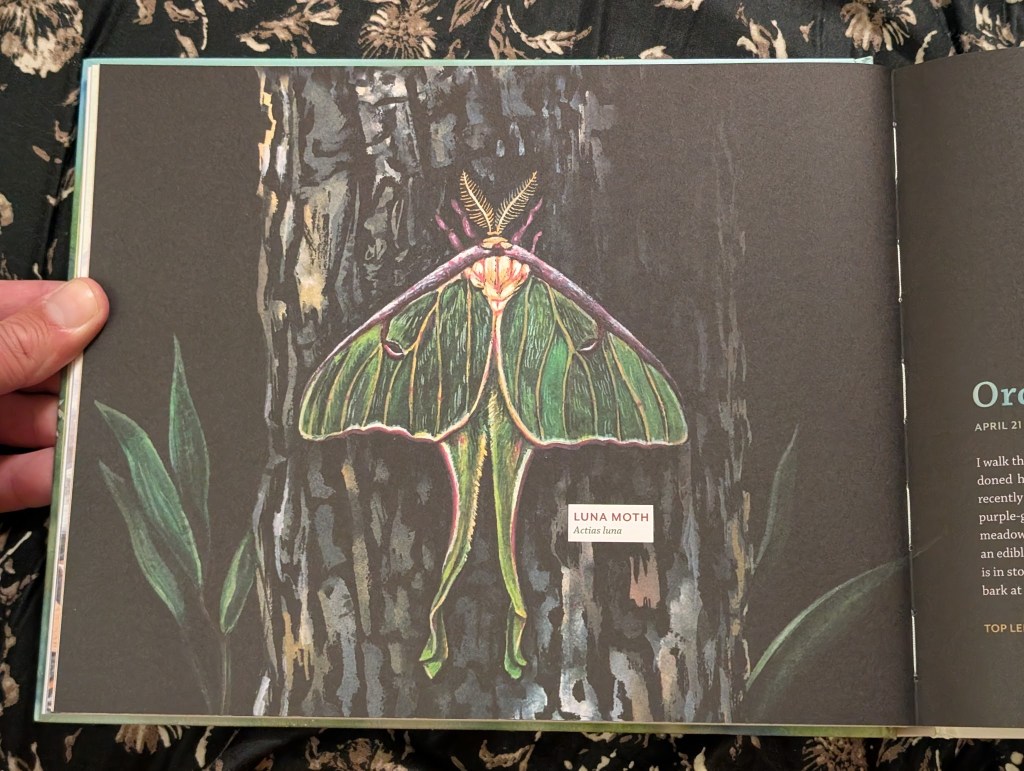
Within the Visitors Center, garden attendees are treated to the original compositions which became the art book Tiny Worlds of the Appalachian Mountains, by Rosalie Haizlett. The book, which came out in 2024, documents the artist’s’ travel along the Appalachian Trail across the course of exploratory months. Based on quiet and careful observation, the book documents and highlights beautiful encounters with some of the creatures (animals, plants, fungi, people) that make these ancient mountains a truly special region. Many species in the book can be found in the Botanic Garden, as well as the Appalachian sites where Ms. Haizlett encountered them.
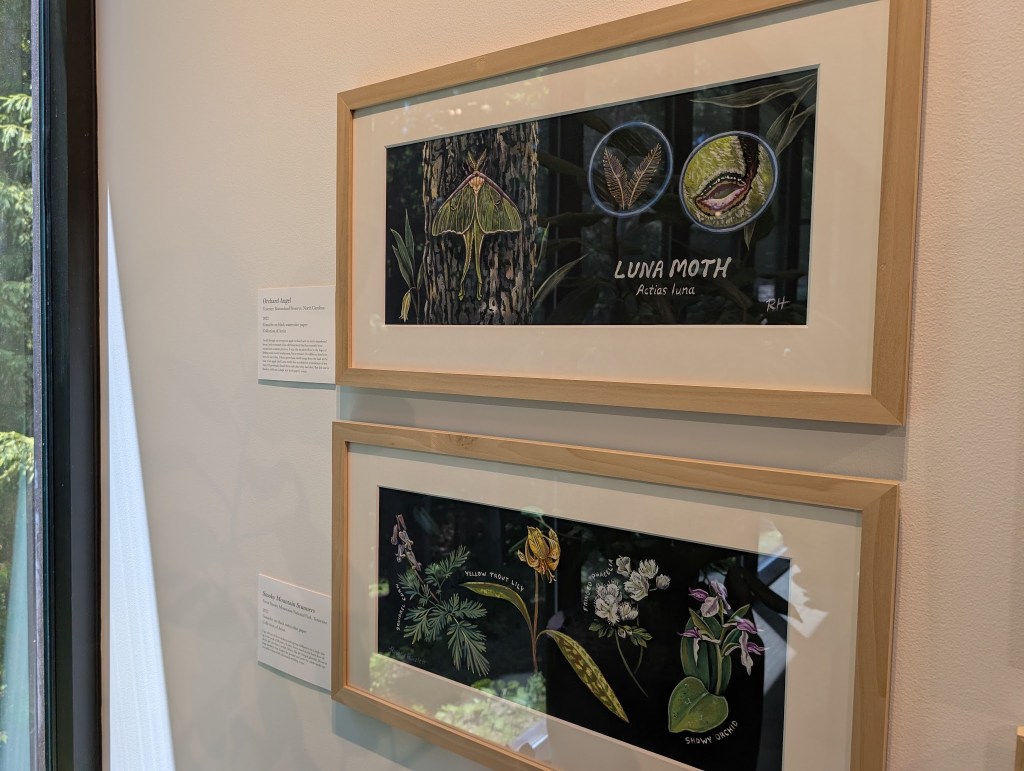
Tiny Worlds is important art because it brings everyone who sees it to the slow, careful, observational, low-to-the-ground eye of a child, a student, someone fresh to the world. The rich, detailed illustrations mimic a worldview where every forest creature glittered and glowed with new, strange, beautiful qualities. To carefully appreciate these studies in natural smallness before stepping into the Gardens is a wonderful way to ground yourself into the visit – they are some of the best work to have graced the walls of the Visitor’s Center.
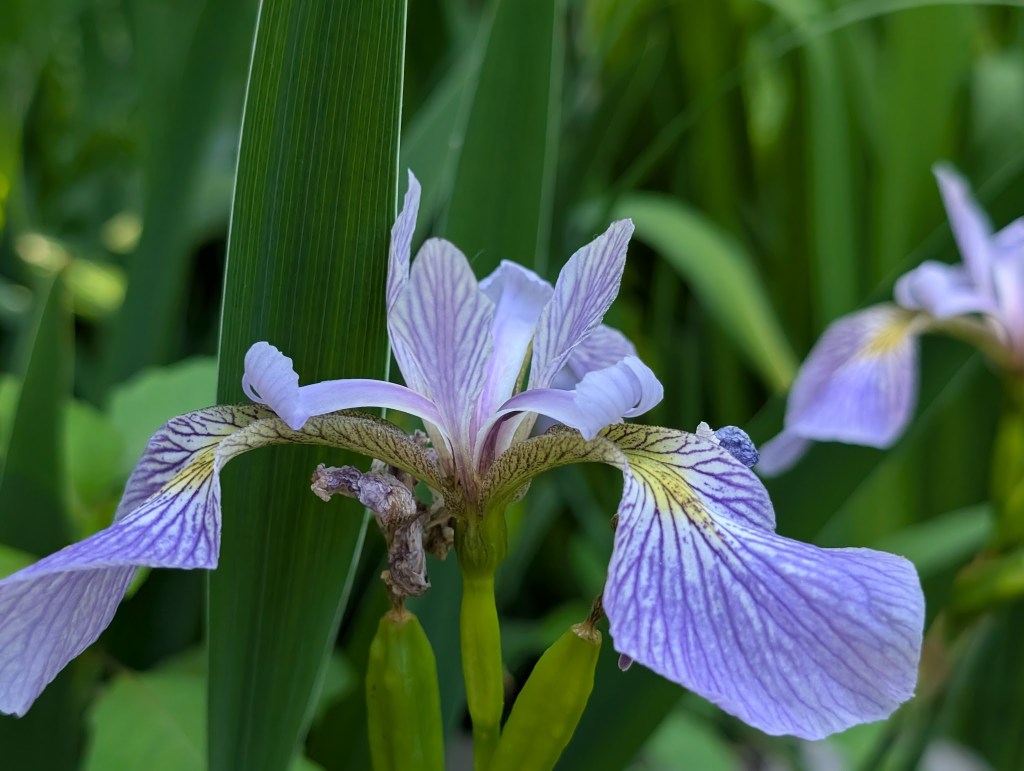
To look at these paintings closely is an invitation to do what the artist did, to be in the moment, to get low, to be quiet and observe the beauty all around in the present moment. There is great power in this practice of slow observation – it is one of the foundational practices of culture-making, the font from which such acts can spring. The gardens offer such an opportunity in the coming weeks to contain such experiences.
The Appalachian Mountains arose 300 million years ago, in rock-raising events which happened millions of years before living things developed bones. They have been as tall as the Himalayas are now, and their erosion-bourne material provides the soils for the majority of the States of the USA, all the way out to the former inland seas of Arizona and Colorado. These mountains have been mysterious that whole time, giving their residents stranger and stranger glimpses of queerer and queerer things. Now we have salamanders which are the size of an arm, and thousands of delicate, mountain-island flowers – an American Rainforest.
Connecting with that long, artistic arc is important each time, even though each time is different. A short 1974 poem by Philip Larkin comes to mind, as applicable to the trees of the garden as to the visiting work
The Trees
The trees are coming into leaf
Like something almost being said;
The recent buds relax and spread,
Their greenness is a kind of grief.
Is it that they are born again
And we grow old? No, they die too.
Their yearly trick of looking new
Is written down in rings of grain.
Yet still the unresting castles thresh
In fullgrown thickness every May.
Last year is dead, they seem to say,
Begin afresh, afresh, afresh.
Rosalie Haizlett will be giving a talk to Botanic Garden members on July 28, at the end of the exhibition, at 10AM. Please call 412-806-0916 for membership and for registration for the event.
Connor Sites-Bowen is an author and illustrator in Pittsburgh, Pennsylvania. A Field Guide to Newtopia, his current project, is an illustrated gazetteer of 36 utopian biomes. You can find his newsletter at https://www.connorsb.com/dispatches.


Leave a Reply