by Emma Riva
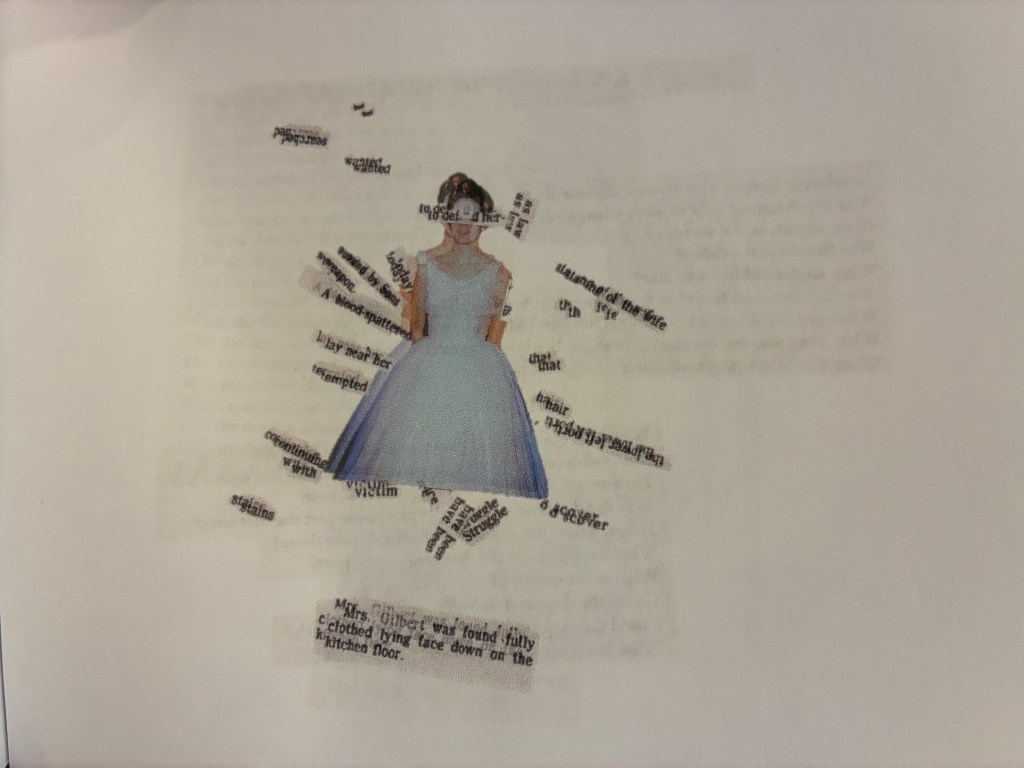
Cover image: Collage artwork by grace (ge) gilbeert in Holly
Poetry is space and absence. It allows language to shape absences, creating non-standard gaps in the reading experience and rearranging the flow of words on a page. It’s no wonder, then, that so much poetry explores loss. grace (ge) gilbert’s Holly takes this concept one step further by composing poems out of literal scraps of worn paper. The book is an art object in and of itself, the design choices adding to the emotional undercurrent of the book. Holly fuses prose, poetry, and collage as gilbert tries to parse and make sense of their grandmother’s murder, which occurred when their father was a young child.
I feel a tightness in my chest and a sadness behind my eyes when I flip through the book. After reading, I have to look off into space for a little while. I have a particular attachment to the women in my family’s past whose stories I never got to hear from their own mouths and whose suffering predated my birth, and the book brings up those emotions tenfold when I look at the fragmented words on Holly’s pages. For me, it is not an easy read, but that’s to its compliment. It’s rare in our overstimulated, oversaturated world that a book can really draw your emotions out of you to that extent.
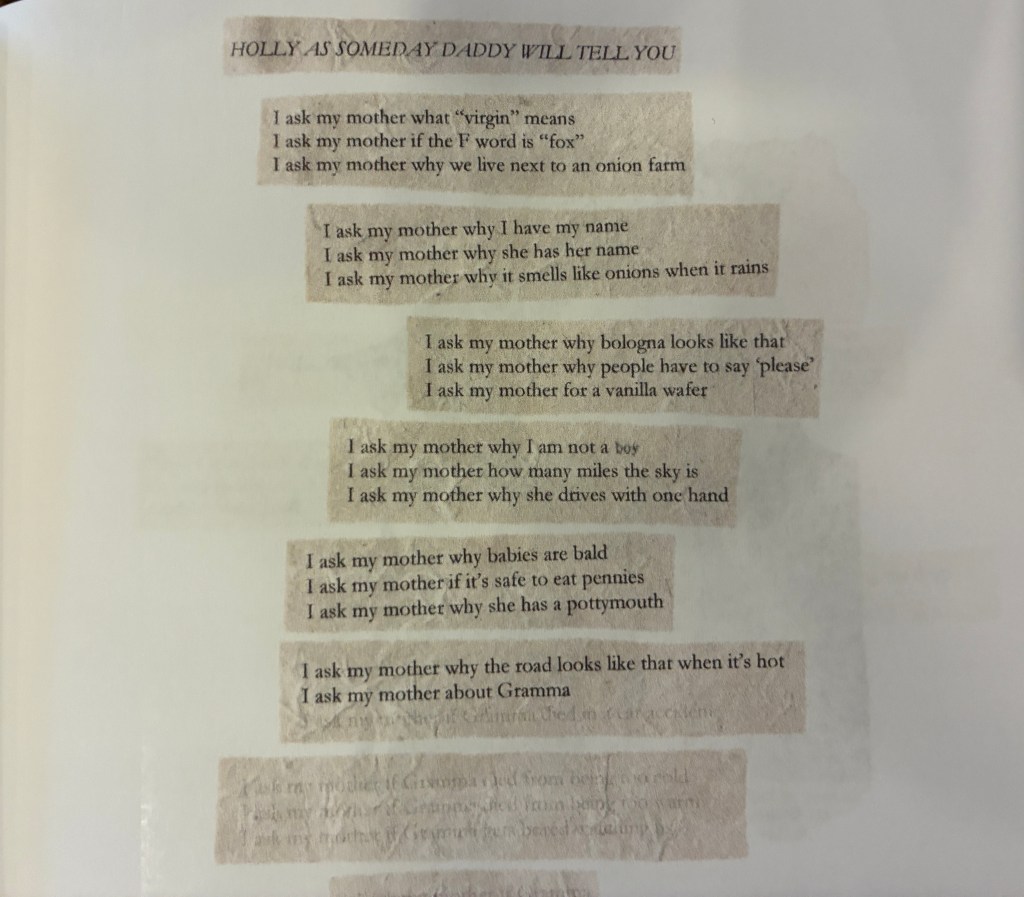
Holly is not a standard exploration of generational trauma—it rarely deals in those truisms about the body keeping the score that have by now almost become cliché. Instead, Holly grounds the complexity of generational pain spatially in sensory detail. gilbert evokes the bleak emptiness of western New York, the place where fire-and-brimstone spiritualism was born. One of the things that becomes apparent reading it is a resistance to believing suffering, pain, and violence have a higher purpose, or that endless intellectualizing about things that happened before you were born even gets you anywhere.
“When I can’t fully piece it together, I cling to loose truisms like they’re mile markers in the dark,” gilbert writes, and then, in a later part of the book: “I drove her Subaru up and down the bleak Northern highway, the air so bitter and black I made a habit of staring at the white lines on the side of the road just to have something to fill the darkness.”
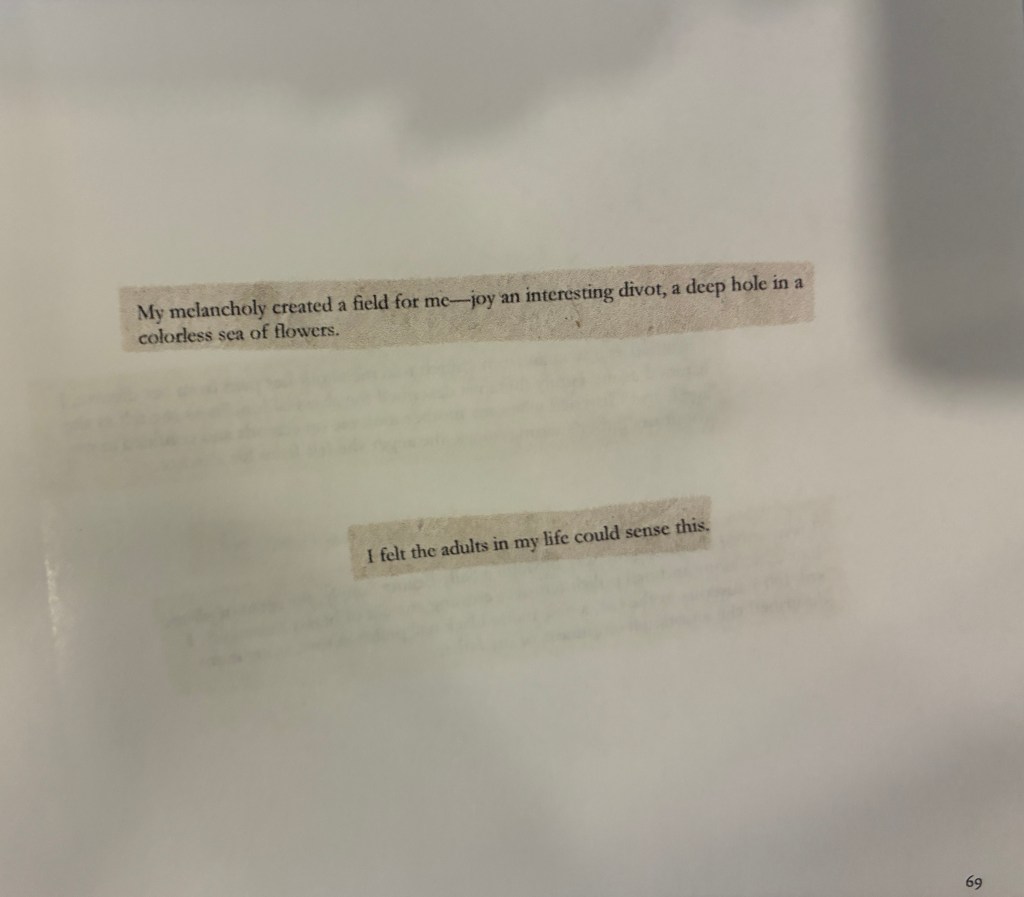
The gaps between the fragments create a visual experience between reading and looking at an art piece. It allows gilbert some room for intentionality and gives the reader space to wonder what sits in the gap between “My melancholy created a field for me—joy an interesting divot, a deep hole in a colorless sea of flowers” and “I felt the adults in my life could sense this.” The word “divots” comes up frequently, later again when Gilbert describes that “The divots in my office wall are peeling.” There are echoes of Maggie Nelson’s Something Bright, Then Holes and Prageeta Sharma’s Grief Sequence in the way the repetition of language attempts to reconstruct gilbert’s memories.
gilbert mentions in the acknowledgments drawing inspiration from Carmen Maria Machado’s In the Dream House, and readers can see that in the section titles being “Holly as ___,” but also in the non-linear way the book approaches memory. Holly does not shy away from the visceral nature of the pain it explores and the shocking violence the memories spring from. “Sometimes I wonder why she didn’t fight harder, / Why she couldn’t hold the knife with the power of mothers in literature, mothers in films, mothers who can move boulders with a single pinky full of love,” gilbert writes, giving themselves permission to go to the real emotional places those in the orbit of violence go that veer outside of the fairytale norm. “Sometimes those thoughts shoulder into her story until I remember that she was no just a mother, she was a self,” gilbert concludes.
One of the most emotionally biting parts of the book is a series of pages with the refrain “I feel thick love, and an absence.” Holly sees gilbert trying, through words, to reconcile nurture and loss—that a childhood, a relationship, a life, being not all bad does not necessarily make it good. Thick love and an absence (and love and fear, and joy and pain) are not mutually exclusive, and that makes it hurt more.
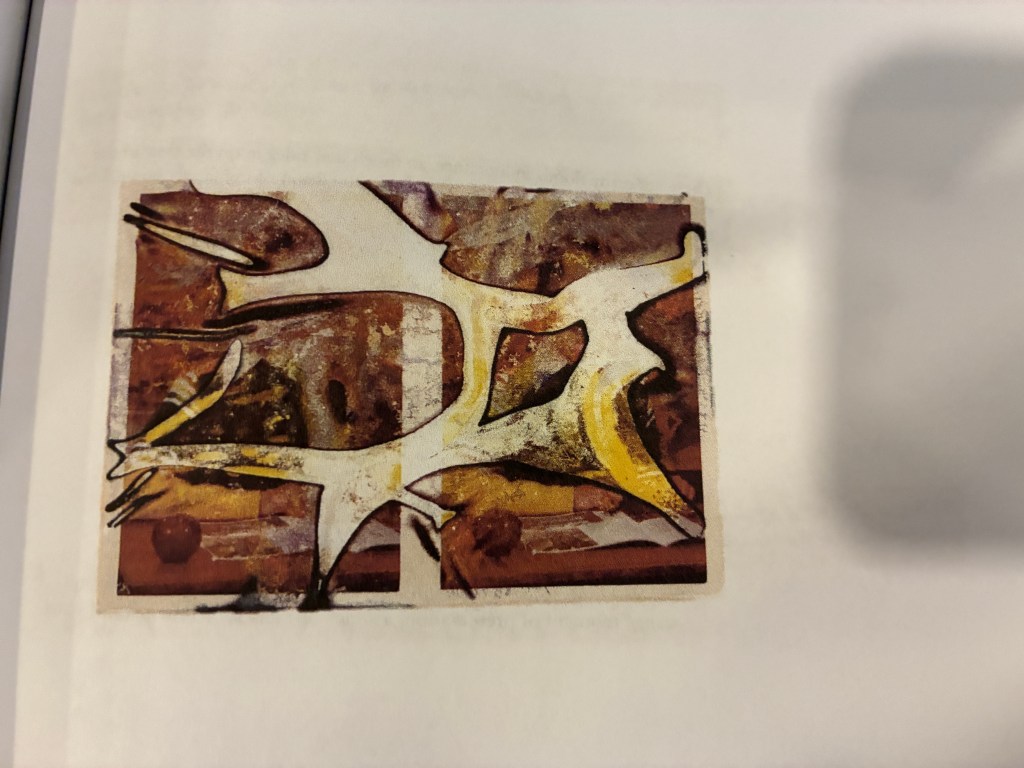
At one point, gilbert recalls their father saying his deceased mother was “the glue” that held the family together, and that without her, the family did not know how to hold itself together. This brings new meaning to the fragmentation and space. gilbert describes their mother’s close friend saying to them that their grandmother is “a part of [you]” and that “it’s important that you know this part of you.” This exchange brings to mind whether the conventions around generational trauma—that it is a birthright passed onto a child with no choice—are really comforting explanations. The feeling that there is something inexplicable inside of you that you had no choice in and no way to extricate it frays at the words in the book. Collage artwork gilbert intersperses act as a way for the pieces to reassemble and bridge the spaces of loss.
Holly is a book where readers have to decide whether they see it as a poet speaker or as Gilbert themself telling a literal, memoirist account. Though the book is confessional in nature, there are undoubtedly things gilbert kept for themself, as they should. The complexity of gilbert’s relationship with their father retains a private intimacy, and my experience of the book was that gilbert’s father’s grief was treated with respect and care. The book ends on an ampersand, an unfinished line just as gilbert’s grandmother’s life was cut unfinished. Holly does what many of the greatest works of art do, it harnesses the power of its medium to get to the deepest emotional core. gilbert has a deft mastery of poetry as not just a way of communicating but as an art form with contours and refinements. There are certain pains a writer just can’t express in any other way. It is a privilege to get to digest that kind of work and be a part of that story as a reader.
Holly by grace (ge) gilbert is out now from YesYes Books. Gilbert received their MFA in poetry from the University of Pittsburgh in 2022, where they now teach. They also teach hybrid collage and poetics courses at Brooklyn Poets, Minnesota Center for Book Arts, and other institutions. Learn more at gracegegilbert.com.
 PETRICHOR
Leave a comment