Interview conducted by Emma Riva
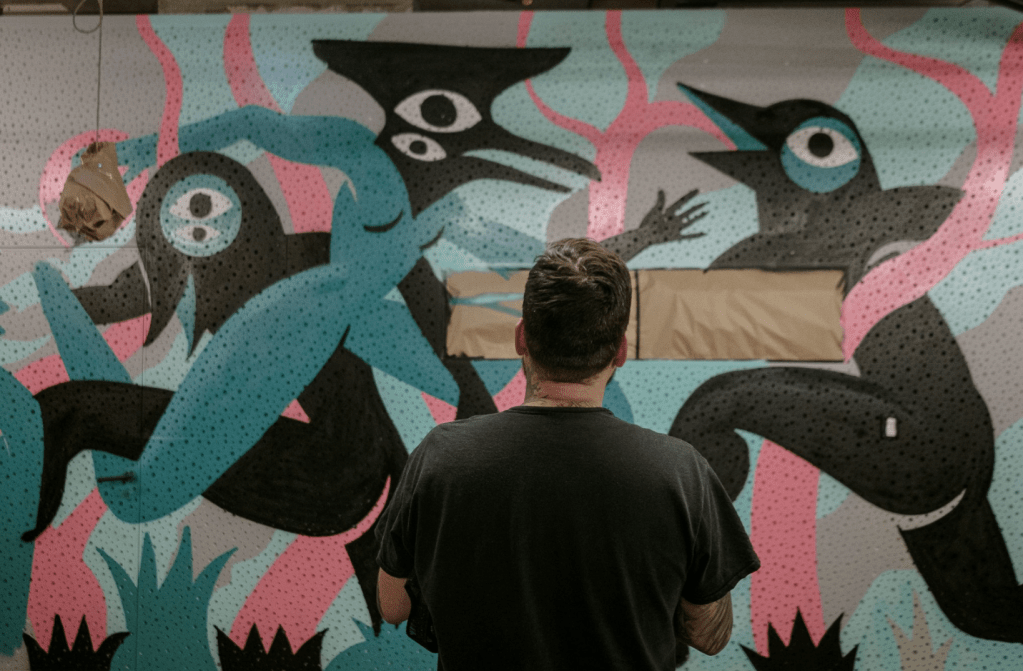
A look at illustrator and activist Tomás Ives’ work feels like looking both back into history and forward towards the future. The images in his paintings and murals draw from Latin American folklore, but they have a universal kind of exuberance and mystery to them. Ives came of age in anarchist and punk scenes and his work is a prime example of how self-expression is a revolutionary concept and a freedom not to be taken for granted.
Ives has a cousin in Pittsburgh and has visited the city several times, but this fall will be doing an extended residency with HCUAP (Hemispheric Conversations Urban Arts Project). Before starting the mural residency, he will be exhibiting his work at Atithi Studios in a show titled Interscapes. I spoke to Tomás about his background in the punk and anarchist world and how his practice changes across mediums in advance of the opening of Interscapes.
What kind of work will you be exhibiting in the show at Atithi?
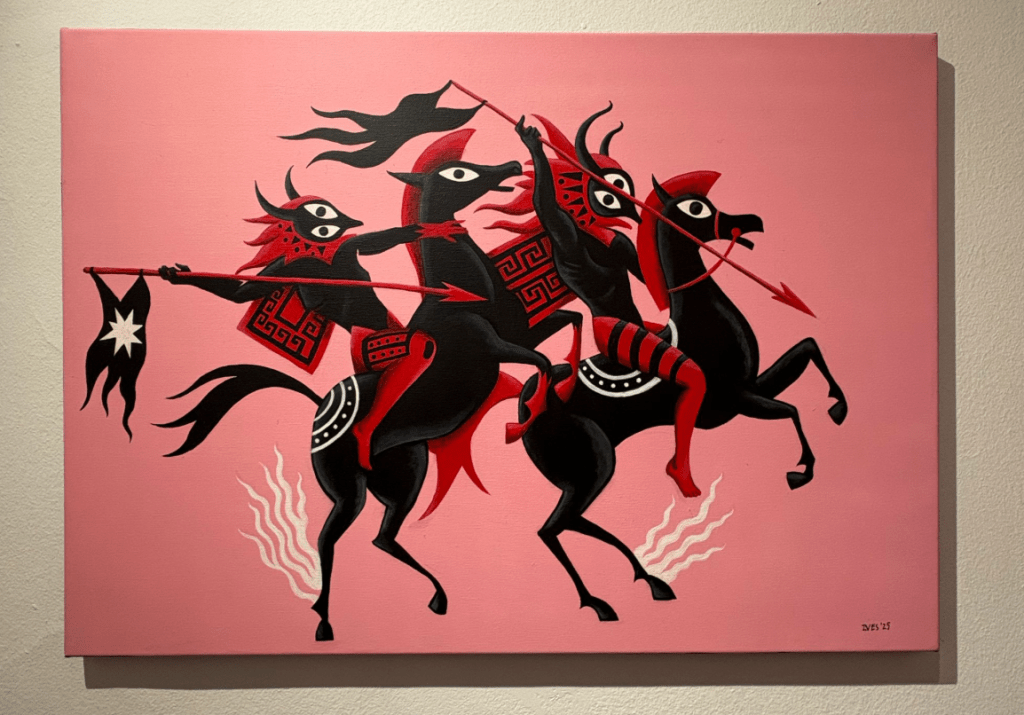
Tomás Ives: At Atithi, I’ll be exhibiting a process I’ve been experimenting with over the past three years: moving my murals from the wall to canvas using the same materials—spray paint, markers, and acrylics. This time, I’m moving from caps and thick tips to paintbrushes. It’s been a very intense yet deeply rewarding process.
We’ll see pink backgrounds, white planes, red shapes, and dark figures. All of them are looking to share a collective imagination rooted in Latin American folk art, present not only in the Southern Cone but throughout the entire continent. A collection of more than 20 paintings in various sizes and several silkscreen prints that I hope will resonate with the Pittsburgh audience.
You work in a lot of different mediums – prints, paintings, murals. How do you translate your style and vision across each one?
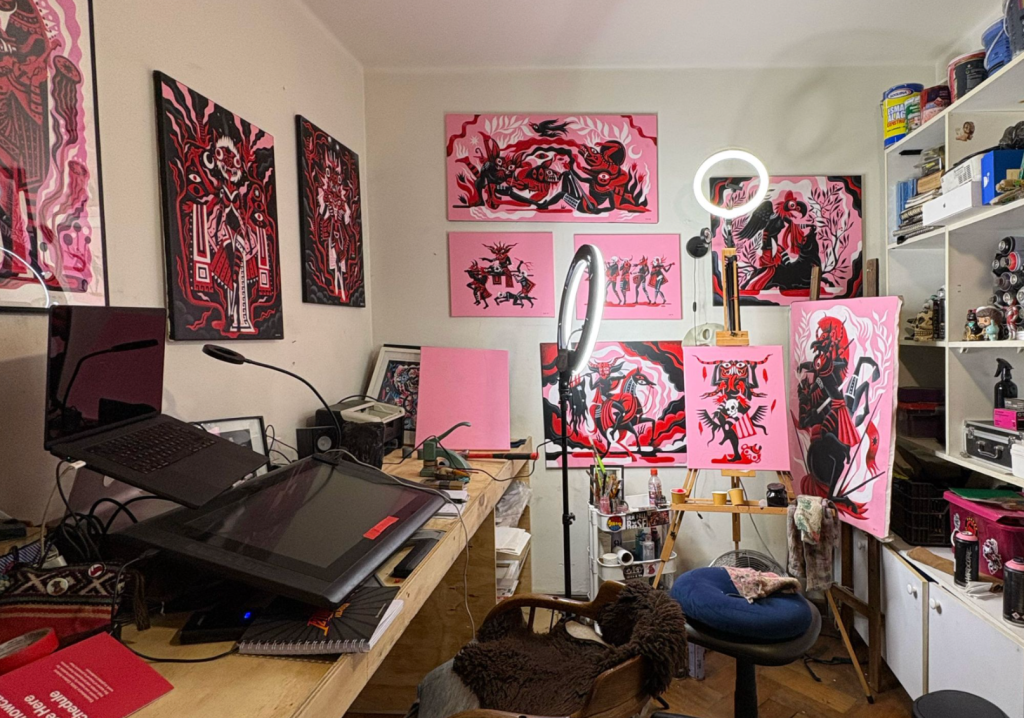
TI: You know, when I started out in this career, I began as a cartoonist for a local newspaper in southern Chile. I’d been drawing my whole life, using all kinds of materials, from gouache to oil paint, and back then—20 years ago—graphics tablets were still a thing of the future.
That’s why I’ve always thought about images, graphics, and art from a perspective where you can use any medium. In my case, I see style as a trail or a path, a period of time that we travel through, and what we are leaving behind defines the style we have today, regardless of the medium.
“In my case, I see style as a trail or a path, a period of time that we travel through, and what we are leaving behind defines the style we have today, regardless of the medium.”
Moving from a blank sheet of paper to pixels, walls, and fabrics is part of the challenge of the journey you take as you go. I think that at some point in the future I’d like to start creating physical, tangible objects. I’ve been thinking a lot about Thaddeus Mosley, who passed away this past March, and whom I had the opportunity to meet last year. He knew how to take the forms that nature offered him and turn them into wonderful objects. I wish I could think and create that way.
You have an existing connection to Pittsburgh, but it’s a very different social and political climate than Chile. What do you hope people in the city take away from seeing your work?
TI: I certainly have family ties to the U.S.; part of my family traces its roots back to an American immigrant in Chile, early XX century.
I had the opportunity to visit Pittsburgh last year. During that trip, I was fortunate enough to meet many people and show some of my work, prints mostly.
It was very rewarding to see my art so well received by the community. I truly have high hopes for my time in the city this summer.
The political climate is, without a doubt, different from Chile. However, I believe that the consequences of our actions are felt, in one way or another, on a global scale. We’re going through similar conflicts, with different nuances and histories, but they all share similar topics, from housing, environment, far right or AI. In that sense, I believe we share a similar “zeitgeist”, idea of an epochal shift.
“I believe that the consequences of our actions are felt, in one way or another, on a global scale. We’re going through similar conflicts, with different nuances and histories, but they all share similar topics, from housing, environment, far right or AI. In that sense, I believe we share a similar “zeitgeist”, idea of an epochal shift.”
Perhaps through that very feeling we can connect with shared imaginaries. The invitation is to recognize in the characters, landscapes, and forms a collective imagination, where the world vibrates, changes through constant hybridization, and, as Gramsci would note:
“The old world is dying,
The new is slow to emerge.
And in that gap
monsters arise.”
Can you talk about the role of anarchism and political activism in your work?
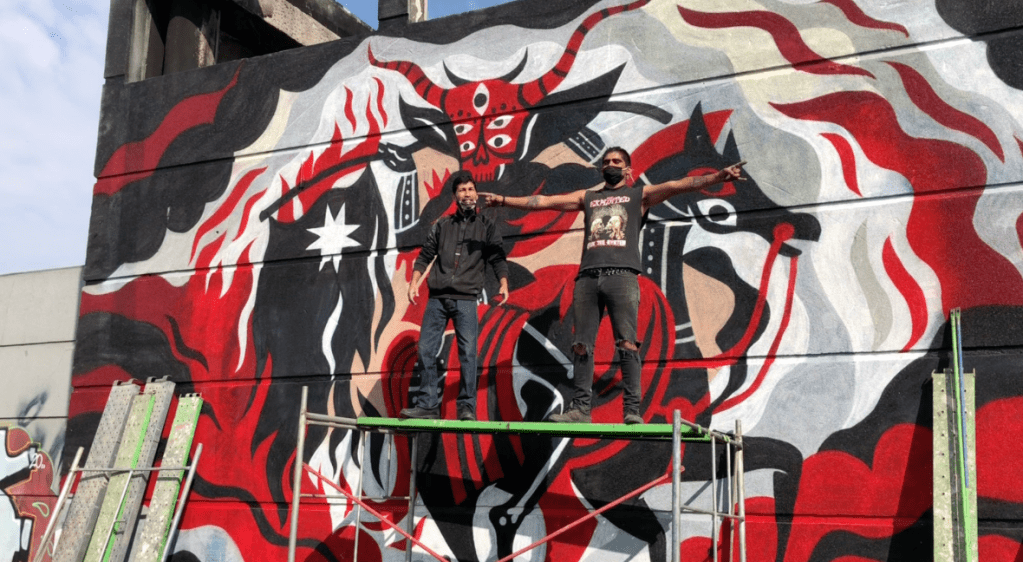
I feel that utopias are a driving force for thinking, moving forward, and creating. I’ve always been drawn to rebellion and disobedience. To the right to question everything, to have the freedom to experiment and not to impose restrictions, from the very depths of our human soul. My adolescence was shaped by punk and anarchist youth movements, where fanzines, posters, patches, and drawings were used as a bold statement to the world.
I love it when we’re able to take ideas to places that go beyond logic and figuration, breaking free from the constraints imposed by our own eyes.
In that space, I find a profound freedom rooted in the horizontal idea that it’s not just institutions that can decide which creations deserve recognition and which are reduced to craftsmanship, hobbies, or decoration.
Art, then, approaches anarchism when it does not merely limit itself to imagining another world, but redistributes the power to imagine it, decide upon it, and build it. These have perhaps been my most powerful experiences in recent years, working in migrant communities and settlements in Chile. There, creation functions as direct, concrete, and political action; the mediums employed contain something of the world we want to build without losing beauty or harmony.
“There, creation functions as direct, concrete, and political action; the mediums employed contain something of the world we want to build without losing beauty or harmony.”
You will be spending the fall in Pittsburgh doing the mural residency with HCUAP as well. What do you plan to accomplish during that?
TI: I’m as happy as I am nervous. I’m really looking forward to sharing my art with the city by decorating one of its walls with a message of unity and empowerment.
I’m also eager to participate in and support my colleagues’ projects this year during the residency so I can learn from them.
I know I’ll meet many talented local artists and community leaders with whom I hope to build connections. I believe that a creative person’s growth depends on a supportive community, and in the case of this residency, I feel it’s the ideal space where such communities come together to create a network of people working from their neighborhoods to the world.
Tomas Ives’ Interspaces opens August 8, 6PM at Atithi Studios (1020 N Canal Street).
Emma Riva is the founder of Petrichor.


Leave a Reply