by Mingsi Ma
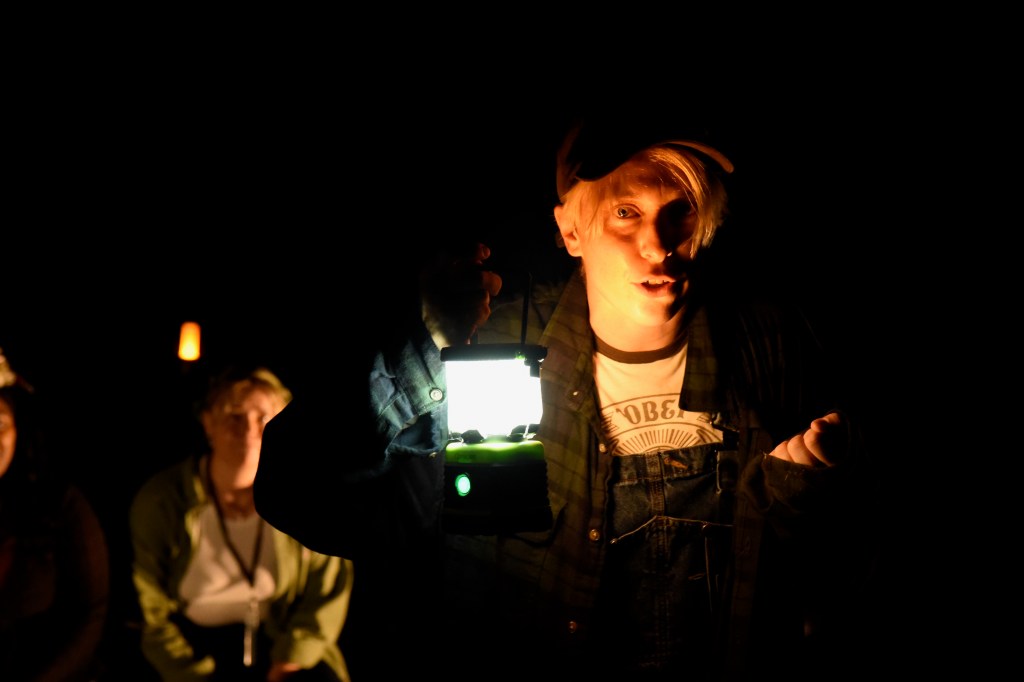
As night falls, Camp Guyasuta is soaked in the songs of crickets and cicadas. I follow the person in front of me, moving through the woods toward center stage. Having grown up in a rather “urban” environment, I am fascinated by how a less-than-20-minute drive in Pittsburgh can take me somewhere I can breathe in the fresh scent of the trees. Walking at dusk, the smell of the smoke from the firepit, the dim outdoor lights, and the sound of an acoustic guitar create an otherworldly, free-spirited atmosphere that draws the audience in.
Vigilance Theater brings Campfire Stories back to Camp Guyasuta again for the third year, and I can certainly see why they insist on returning to the same location. The setting itself is exactly what makes the production immersive, allowing the theater experience to begin long before the performance does. In this sense, Vigilance Theater lives up to its name as an immersive theater company.
Directed by Tal Kroser, Campfire Stories reminds me of a hodgepodge with a diverse mix of ingredients: a little bit of campfire tradition, a little bit of folklore, music, and theatrical storytelling, all gathered around the same fire. Before the performance starts, we the audience, hang out around the fire pit and enjoy warm, freshly roasted s’mores. The fire pit sits at the center of the night, bringing people together just like how our ancestors once sought out the warmth and safety of fire at night. Flow arts and fire performer Ashley Lucas elegantly spins a lit fire loop and steel fan in front of the fire pit. The contrast between the danger of fire and Lucas’ graceful movement adds another layer to the mystery, with an alluring tension.
At the heart of the evening are four cryptic stories and folklore about mythical creatures – the Wampus Cat, the Earworm, Mothman, and the Squonk. The telling of these stories can be scary at times, but they can also be whimsical, playful, and even a bit silly.
Looking at Campfire Stories holistically, the immersive aspect of it stands out thanks to the carefully chosen venue. The fire pit, the woods, and the darkness of the campsite add so many natural sound effects and layers of flavor to the production. When the Not-Deer emerge from the pitch-black woods and silently make their way across the stage, their red eyes glow in the darkness. With costume and creature design by Allie Lampman-Sims, the Not-Deer look just familiar enough to resemble deer, yet disturbingly not quite so. It is one of the evening’s most frightening highlights.
Lelaina Vogel in Campfire Stories. Photos by Renee Rabenold
Still, this performance has much more room to push the storytelling further during the four core stories. I have to say I get rather hesitant when I see actresses Elizabeth Glyptis and Katy Grant-Blair hold the script during their section on the Earworm, as this affects their coordination and delivery of the lines. But I don’t think the presence of the script alone is what leads me to this comment. Even when actresses like Carly Chotiner and Lelaina Vogel deliver highly skilled and engaging solo performances, I found myself wanting more from the theatrical elements surrounding them.
At times, spooky sound effects and lighting accompany the performances. Yet, rather than feeling fully integrated into the storytelling, these elements can sometimes feel more like atmospheric additions to what the actors are already doing. As a result, I find myself wanting moments that feel more visceral and organically integrated with the environment. I wonder what might happen if the performances were allowed to spill more fully into the space around us.
In one instance, flashlight-like lighting is cast into the woods, with the beam sweeping across the area as the story unfolds. Such a choice no doubt creates an exciting visual interest and immediately draws attention to the darkness beyond the stage. However, although the shifting focal point successfully builds anticipation, the moment ultimately does not lead to much of a payoff. The production has already created the sense that something might emerge from the darkness, only for that anticipation to dissipate without much happening.
The relatively restrained presentation of the core four stories stands out particularly after the immersive experience Campfire Stories creates before the core performances begin. The opening establishes a mysterious environment that absorbs the audience by surrounding them with the world of the performance. In comparison, the following four stories can feel more like performances taking place within that environment.
For audiences attending Campfire Stories, I highly recommend arriving on time. The venue requires a guided walk from the parking lot. The night is staged as soon as you arrive. By the time you make your way through the woods, you are already pulled into this imaginative experience. Campfire Stories is a good reminder of how the journey into a story can begin long before the first line is spoken.
Vigilance Theater’s Campfire Stories runs September 18 – 19 and 25 -26, 2026, at Camp Guyasuta in Sharpsburg, PA. Learn more here.
Mingsi Ma is a critic, arts writer, and creative industry professional.

Order Petrichor’s very first print issue or subscribe for four issues a year.
Sponsored by the Pittsburgh Opera.



Leave a Reply