by Jordana Rosenfeld
Ambridge-based Iron Horse Theatre Company makes its Pittsburgh debut with an original play about one of Youngstown, Ohio’s most beloved crooks. Trapped, written and directed by Iron Horse leader London Cain, tells the story of real-life disgraced Ohio congressman Jim Traficant, who served seven years in federal prison on bribery and obstruction of justice convictions.
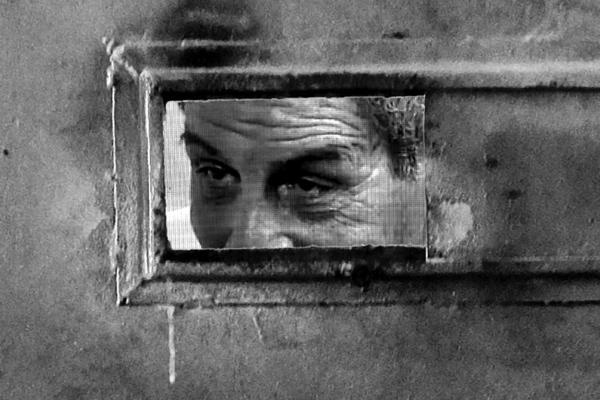
The play depicts Traficant (played by Andrew Pivarnik Jr.) in 2009 during the last few weeks of his incarceration as he suffers through solitary confinement and battles with an unknown woman he believes is his biographer. The mysterious woman (played by Amy Sikora Baschnagel), who Traficant addresses as “Lisa,” presses Traficant to account for his political missteps and accomplishments, which allows him the opportunity to outline his self-mythology at length. A gruff but uncommonly compassionate correctional officer (played by Eric Vollmer) punctuates the drudgery of Traficant’s confinement.
Traficant himself is a fascinating, largely forgotten piece of Rust Belt history. He began his political career as a champion of the “little guy”—as sheriff of Ohio’s Mahoning County in the early 1980s he refused to serve foreclosure notices on laid-off steelworkers (although he eventually agreed to do so three days into a 100-day jail sentence for contempt of court)—and ended his political career in disgrace, having been convicted of taking bribes, using campaign funds for personal expenses, and forcing his congressional staff to do unpaid farm work on his property.
In between, he was a grandstanding larger-than-life personality, handily winning reelection nearly ten times and managing the astonishing feat of being one of two people to ever successfully represent themselves in a RICO case, despite prosecutors having a recording of a conversation between Traficant and members of the mob where he apparently admitted to taking their bribes. He argued he had taken the bribes as part of a sting operation designed to catch the mobsters in the act of bribing him.
The reason he has been forgotten, Cain suggests, is because Traficant never humbled himself to admit he broke the law, prioritizing saving face over his own integrity. The play posits that Traficant could have been a powerful champion of the working people and an antidote to the self-interested political operators who dominate Washington, if only he had been accountable to his voters.
The historical record bears out the argument that Traficant’s ego impeded his ability to accomplish change; when he was at the height of his seniority in the House of Representatives, his refusal to cooperate with party leadership made him the first rank-and-file representative in a century without a single committee assignment.
The play shows an unrepentant Traficant saddled with a familiar America First-flavored persecution complex, insisting that his prison sentence is a miscarriage of justice. At first, the play seemed to offer a sober-eyed assessment of the damaging psychological effects of prolonged solitary confinement, as Traficant hits and bites himself and hallucinates Lisa. (Indeed, experts worldwide agree that solitary confinement, a foundational aspect of America’s prison system, is torture.) However, as the play went on, Traficant’s captivity functioned more like both a metaphor and, somewhat tritely, Traficant’s last chance for redemption.
As the play goes on, Lisa’s push to get Traficant to admit his lies reaches a fever pitch and becomes a bit tedious. The conflict between them both starts and ends in a deadlock, their argument further entrenching each of them in their own perspectives. Alternately teasing and sanctimonious, Lisa seems more like a pest than a manifestation of Traficant’s guilty conscience, lacking the necessary leverage to knock Traficant out of his rationalizations and suggesting that Lisa, and by extension, the play may be missing insight into the man beneath the bluster.
Jordana Rosenfeld is a writer and critic living in Pittsburgh.

Order Petrichor’s very first print issue or subscribe for four issues a year.
Sponsored by the Pittsburgh Opera.



Leave a Reply