by Jess Ambler
I think that at this moment in our country’s history, it’s much easier to feel like we are divided rather than part of something larger, something united. I think this is especially true for those of us in the arts and humanities. It feels like we are faced with new challenges every day. We are all scrambling to find funding, applying for grants that are rapidly disappearing, and many of us are faced with new laws that challenge our artistic and intellectual freedoms, just to name a few. I just visited Pittsburgh for the first time as a Pedantic Arts Research Grantee this September, and what I found within the city’s artistic community gave me hope for the days ahead. I met with so many amazing individuals, but what I took away was an appreciation for the many connections that exist there and the way that everyone I encountered spoke proudly of being part of the community. There were not solitary operators but rather colleagues, friends, and compatriots who see the value in mutual support and advocacy because this is how we move forward.
I met with museum professionals, leaders of arts institutes, and art historians. I was also fortunate enough to conduct a series of studio visits with four artists: Brent Nakamoto, Leah Patgorski, Rachael Starbuck, and José Santiago Pérez. I’ve been thinking a lot about these meetings and the personal connections I formed with each artist, as well as the overlapping nature of the visits where certain topics came up time and again. What overwhelmingly united all these encounters, however, was the feeling of belonging that I felt –the sense that I was meeting not just colleagues but kindred spirits and that the conversations we started will be conducted over years, not hours.
Studio Visit I: Brent Nakamoto (Friday, September 4)
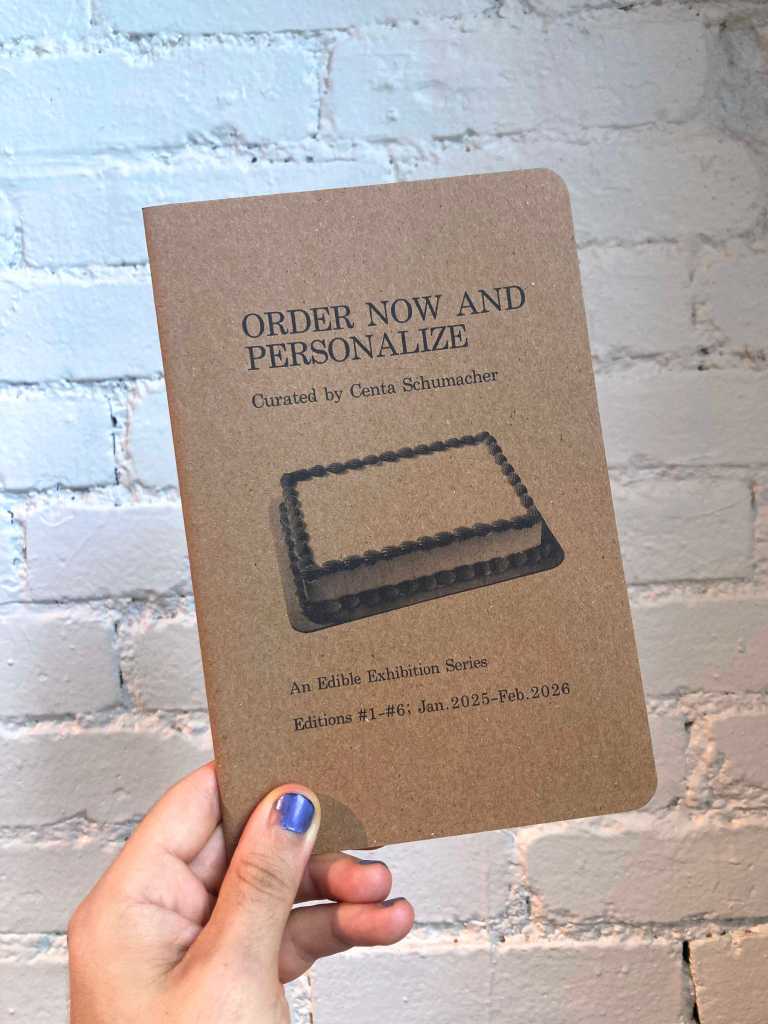
Cover of Order Now and Personalize, published by Brent Nakamoto’s Almost Perfect Press, 2026. Photo courtesy of the artist.
My first visit with an artist was with Brent Nakamoto at Brew House Arts. The beginning of our conversation included a little background story. Turns out, we’re both from California originally (he grew up less than an hour from where I did my undergrad) and we’re both graduates of UC Santa Barbara (Brent for undergrad, me for grad school) and we even overlapped some of that time. He, like the other artists I met, took a winding road to arrive in Pittsburgh, which he now calls home. Nakamoto not only works in a variety of media, with a background in painting, drawing, photography, and printmaking, but he is also involved in teaching, curatorial work, art criticism, and running the Distillery Emerging Artist Residency. I knew I wanted to meet Brent given his involvement in so many elements of the arts, but I was particularly interested in his book arts work and Almost Perfect Press, a small-batch, hand-bound curatorial and publishing project he started.
He shared with me a copy of one of his latest publications, a collaboration with the curator Centa Schumacher to accompany her project Order Now and Personalize, which ran at Brew House from 2025 to 2026. The book has the Almost Perfect Press signature look – an 8.5 x 5.25 in. chapbook with color images and a kraft cover – but it is also representative of the intention behind the press. Almost Perfect isn’t driven by the need to produce profits. Instead, Nakamoto works with artists and curators to help bring their work into a new medium. He chooses projects that allow him to actively collaborate with other artists, combining writing and images in a meaningful way. Brent is doing something truly unique here. He is producing something akin to a livre d’artiste, that will exist long after exhibitions close, extending something temporal and transient into reverent objects. He is also doing something that I found echoed time and again during my time in Pittsburgh. He is building community and camaraderie through collaboration.
Studio Visit II: Leah Patgorski (Sunday, September 6)
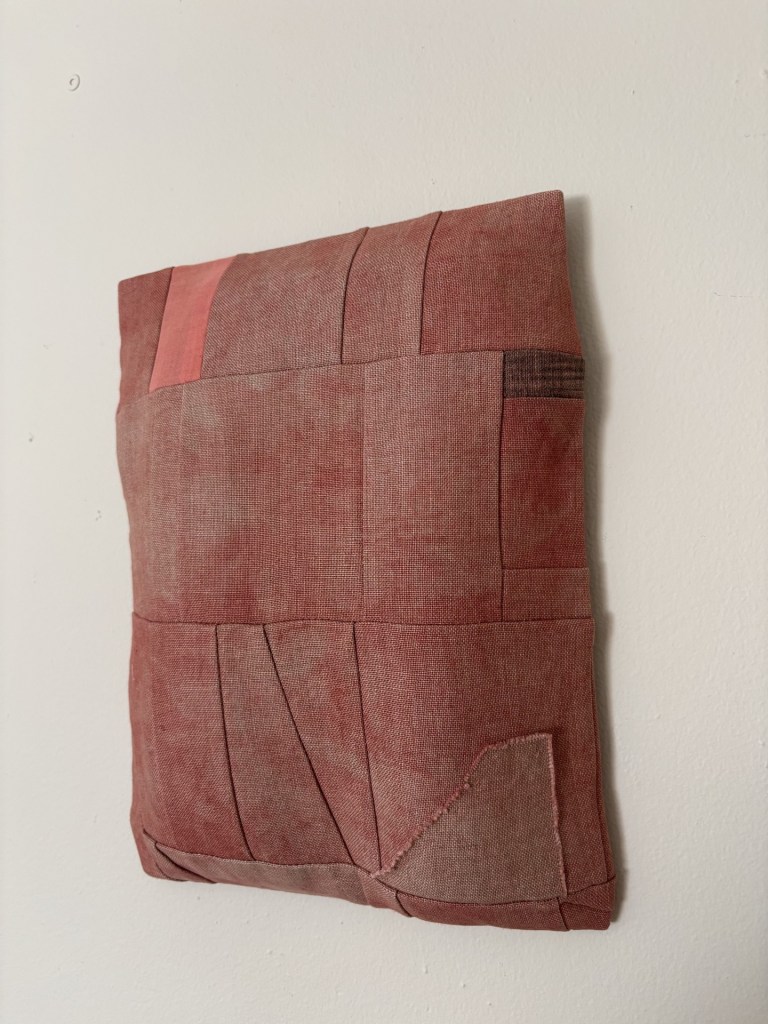
I met with Leah Patgorski a couple of days later for a wonderful lunch on the patio at Noodlehead then a visit to her studio not far away (where Leah introduced me to Petrichor!). I was initially interested in meeting with Leah after seeing images of the beautiful fiber art installations she creates, which are simultaneously delicate and encompassing. I think that part of what makes Leah’s work so unique is that she initially trained as an architect before pivoting to a fine art practice, which gives her insight and sensitivity to how her works can be meaningfully integrated into buildings. She often works on commissions for spaces, and these projects demonstrate the push-and-pull of site-specific work, where art and space commune with one another, and each is used to compliment the other. I’m an architectural historian by training, and I still cannot look at art without looking at where it is located, and wondering why here?
What I was not expecting was the power of Patgorski’s smaller wall pieces. Like her other work, these sculptural forms involve fabrics, but here the fabric is layered and sewn in segments over molded and formed canvases, giving them an organic, biomorphic feel. They seem to pulsate against the wall, projecting into the viewer’s space, and refusing to be seen from a single angle. In all her fabric works, Leah utilizes natural fibers and plant-derived colors which create subtle variations in texture and hue. The hand-made quality of the work ensures that each piece is unique and creates an immediacy between the maker and viewer and where the artist’s hand is ever-present.
As we talked in her studio, Leah showed me pictures of a new type of project she’s working on which she calls “activations” where friends and colleagues are invited to engage with an installation. Patgorski hires a photographer, Elisa Cevallos, to document these moments – some posed, others candid, all playful – to preserve transient events. Her interest here is tied to one of my current goals when planning exhibitions and related programming: deepening audience connections to art through kinesthetic learning. This has manifested for me with the inclusion of “touch tables” and swell-touch imagery in my exhibitions, but Leah is taking it one step further. As the artist, she is baking the interaction into her initial conception of the work, planning from the onset how visitors can create memories with art.
Studio Visit III: Rachael Starbuck (Monday, September 7)
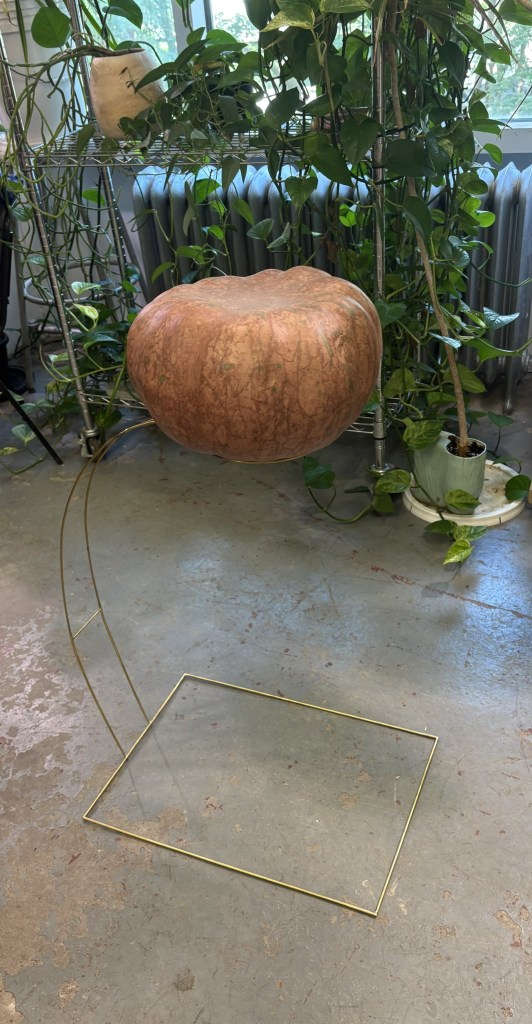
I met Rachael Starbuck in her studio at Carnegie Mellon University on Labor Day while the campus was quiet. In her studio I found a veritable plant nursery, with creeping vines and splayed leaves flooding the room with greenery. Can you believe we both have cuttings from a mother plant that lived in Lee Krasner’s studio? It’s the stuff of art world myth. We’re also both originally from big beach-side cities far from Pittsburgh; Rachel from Miami and San Diego for myself. We got talking about what it’s like to move around the country, live in snowy places, see wildly different flora than we grew up with, and move at a different, less beachy pace.
Starbuck is interested in the relationship between distance and nearness, and a sensitivity to place is inherent in her work. She is a sculptor who utilizes a variety of media such as papier-mâché and poured acrylic paint to create objects that speak to connectivity and longing, the yearning to reach across space to unite with something just out of reach. We looked at a series titled Measuring the distance as if it were the essence of being close, a group of bikinis made of poured sheets of latex house paint in a myriad of blue tones, color-matched to swatches of blue sent to her by friends and family living far away. The strings from the bikinis spill over into exaggerated lengths, suggesting the ties that connect them to individuals in Rachael’s life. Looking at them, I could feel their sagging, waterlogged weight, smell the briny ocean water dripping from them, hear the excited screams of diving below the breakers; I remembered a thousand beach trips up and down the California coast.
Starbuck is also interested in containers – such as pockets – as carriers of meaning. In right between + left between, Rachael created casts of her own pockets in paper clay. What you actually see is the exterior of her jeans (the impression is so clear you see each fold, each belt loop) with the outlines of objects stashed within her pockets, hinting at a presence through absence. As a viewer, you are left to consider just what she has hidden in this tiny, personal world that sits on the threshold of the public domain (so close to bare skin yet also hidden by the clothing that must be worn in the presence of others). She told me about some of the texts that inform her work, in this case Ursula K. Le Guin’s “Carrier Bag Theory of Fiction” that argues the first human tool was a container, and that fiction should act like a carrier bag, holding meaning that is not required to be linear or monolithic. Rachael takes up this thread beautifully in her work. Her containers – not just pockets but laundry baskets and vases – contain stories, people, and places within them.
Studio Visit IV: José Santiago Pérez (Monday, September 7)
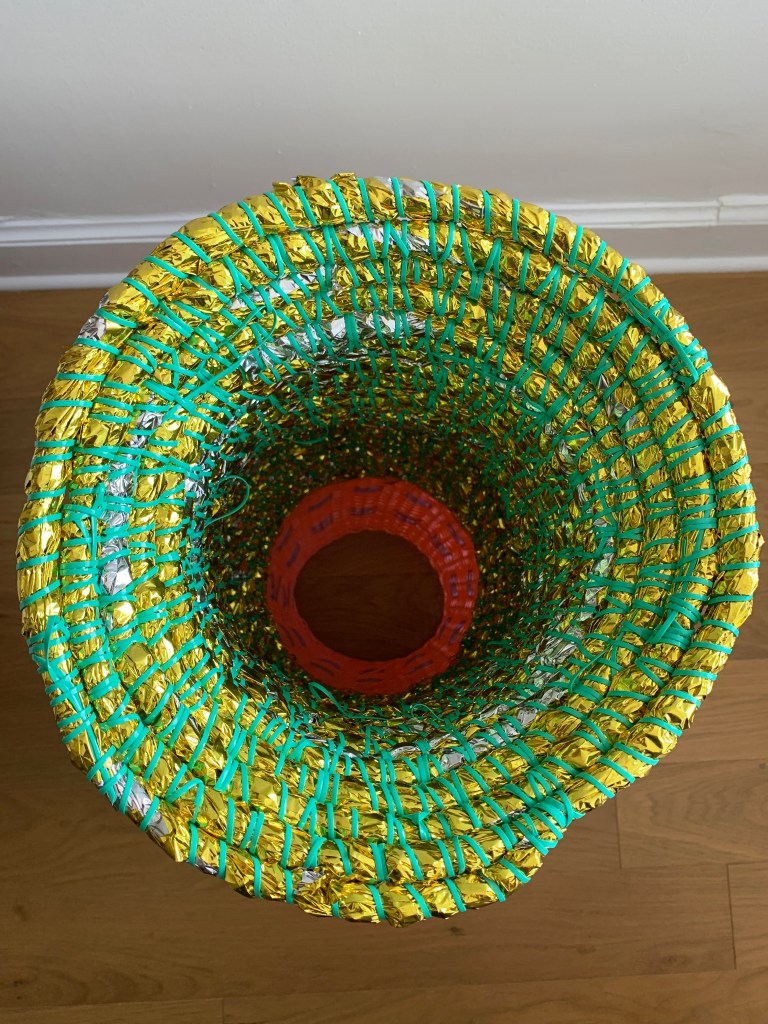
The last stop on my studio visit circuit was with José Santiago Pérez, a first-generation queer Latine artist and maker of sculptural woven works. He is from Los Angeles originally and is a fellow graduate of UC Santa Cruz (go Fighting Banana Slugs!) who graduated just two years after I did. Now he is a Teaching Assistant Professor at Pitt and it’s clear that he is dedicated to mentoring his students; he even invited a student intern working with him to join us for our visit, which made for a great addition. I arrived at José’s studio immediately after meeting with Rachael and I was still thinking about the Carrier Bag Theory. Even though Rachael and José create very different types of work, they are both interested in containers as holders of meaning. Rachael mentioning the essay also reminded me of one of my favorite studio visit questions to ask an artist: What are you reading?
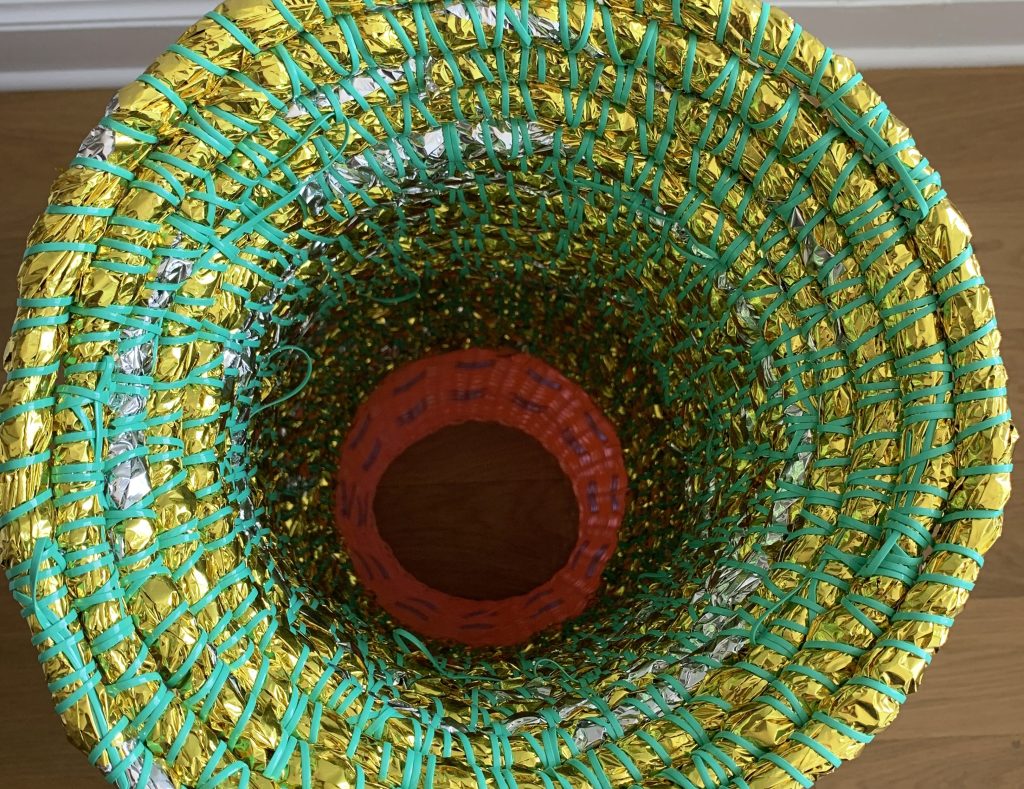
When I asked José he immediately had examples to share with me including Vessels: The Object as Container by Dr. Claudia Brittenham which looks at vessels from Greece, Rome, and China as well as pre-Columbian Mesoamerica, analyzing how containers (pots, boxes, vases) served practical, symbolic, and ritual purposes. This is central to Pérez’s work. He is taking typically utilitarian objects and removing their usefulness, such as baskets without bottoms or the splayed and flattened circular floor works that he makes. While he negates the containers’ functionality, he is enhancing each object’s symbolic purpose and each decision that goes into their creation is made intentionally with purpose. He uses plastic threads because the medium is both rigid and malleable, especially under pressure. He incorporates shiny, reflective strands in many works suggesting mutability and differentiation and he uses just five colors in his work, referencing the “hanky code” that originated in the queer community of the early 1970s.
What José does so well is making vessels that contain many layers of meaning and that are simultaneously personal and universal in meaning. References to queer culture appear in every step of the process from color choice to shape and form but these are containers that also hearken back to centuries of production across world cultures. Like Le Guin’s carrier bags filled with metaphor and messy, non-linear messages, Pérez’s vessels are complex and mutable, they change shape over the course of their production and into their lives on display, their colors shift depending on where you stand, and they are collective, inclusive gatherings of experiences.
With Gratitude
I would be remiss in not acknowledging the many other arts and culture leaders I met while in Pittsburgh. I owe each of you a great debt of gratitude; thank you for your time and for making me feel like part of your community: Alison Oehler at Concept Art Gallery, Heather McElwee at the Pittsburgh Glass Center, Kyle Houser at the Pittsburgh Center for Arts and Media, Silvia Filippini-Fantoni and Nicole Lampl at the Westmoreland Museum of American Art, Harrison Apple at the Frank-Ratchye STUDIO for Creative Inquiry, Rachel Rearick at Contemporary Craft, and of course everyone at Pedantic Arts (Henry Simonds, Hannah Turpin, and Kaylani Brown – you made this happen and I couldn’t be more grateful!).
I was given a piece of great advice: don’t overschedule the time in Pittsburgh because as you meet with people, you will inevitably be introduced to many others along the way. This was certainly the case for me and I can’t imagine anything better. Pittsburgh is the perfect container: full of connections, ideas, inspiration, and community members dedicated to making the city’s art ecosystem thrive through collaboration. Even as I pack to leave, I know that this is not goodbye, it’s merely see you again soon, Pittsburgh!
Dr. Jess Ambler is the Director of the Eleanor D. Wilson Museum and Co-Director of the GLAM (Galleries, Libraries, Archives, and Museums) certificate program at Hollins University. She has a Ph.D. in art history from UC Santa Barbara with a specialization in ancient Roman architecture and city planning. Jess has over a decade of experience in the art world including work in museums, an auction house, art advisory, and numerous universities.
Order Petrichor’s very first print issue or subscribe for four issues a year.
Sponsored by the Pittsburgh Opera.



Leave a Reply