by M Dillie
Emily Culver’s exhibition, Holotyped, has occupied significant mental real estate since I visited The Sculpture Center in Cleveland last month. Dictionaries define the holotype as a singular representative specimen designated to formally label, classify, and standardize a species. It serves as the prime example of a species and is used as a reference for comparison of all others like it. But this exhibit uses the term in its adverb form, Holotyped, revealing Culver’s intentions to trouble the idea of categorization itself—to show how some bodies refuse to be pigeonholed.
Upon entering The Sculpture Center, we step into a gallery where Culver’s pieces neatly line the brick walls. The works primarily consist of metal, glass, and stone. Along the right side, a row of five small structures emerges from a sickly green rectangular panel. The structures initially resemble a fetus, and as we move across the room, they begin to open and expand, like a flower, resulting in a singular form that hangs from its own separate panel underneath a glowing round orb of cool white light. This panel is different—a small SOMSO Modelle logo indicates that we are looking at an anatomical model, something a professor might use in a lecture hall. This is the holotype.
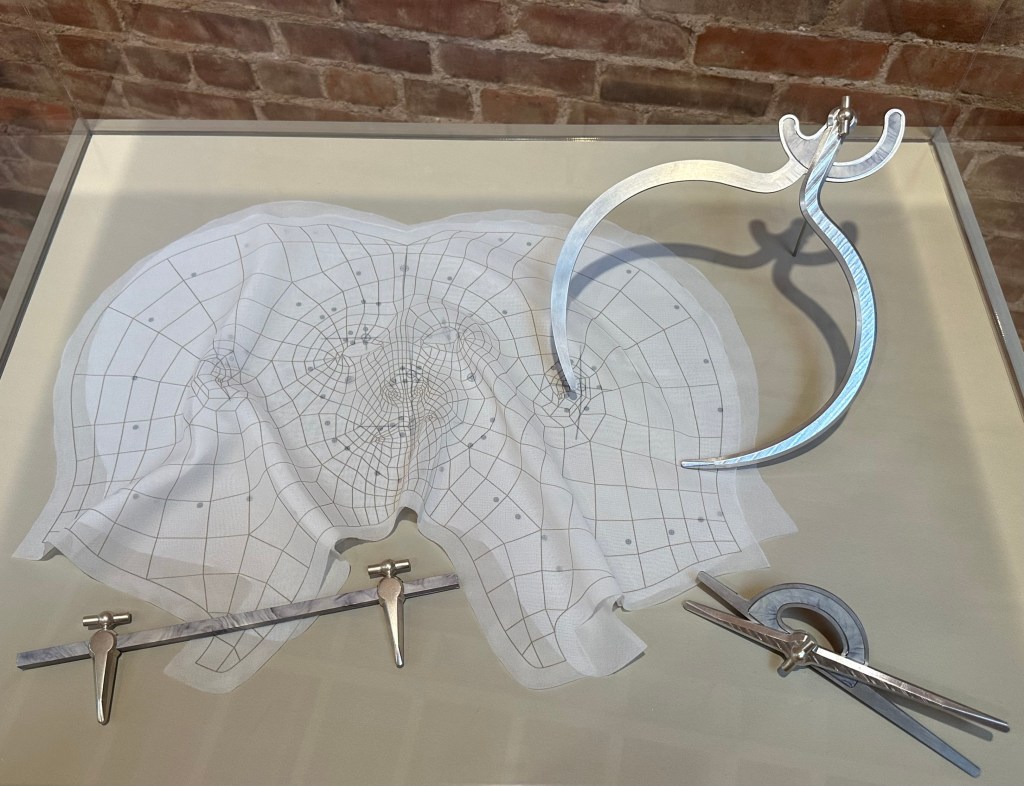
Beyond the initial installation, other pieces occupy clear display cases and sit atop white pedestals. In one of the cases, we see Inheritance, a spread of two objects that mimic retroverted uteri. In another, we see Adam’s Baculum, an imagined extra-skeletal human penis bone. These objects represent the grotesque, the politicized transgressions of the human body. This is the clinical made strange, precision abstracted, privacy made public. We can note that these hybrid forms make repressed bodies visible, but what good is visibility without power? And which bodies are deemed illegitimate and unintelligible in comparison to the holotype? The items inside the remaining cases resemble calipers, protractors, speculums, and probes—the cold, clinical apparatuses of the medical industrial complex. In one of these cases, we see Error 404_Speculums for a Glitching Womb, a set of three pewter sculptures that resemble transvaginal probes. Who wields these instruments? And which people are subjected to the use of these devices on their own bodies?
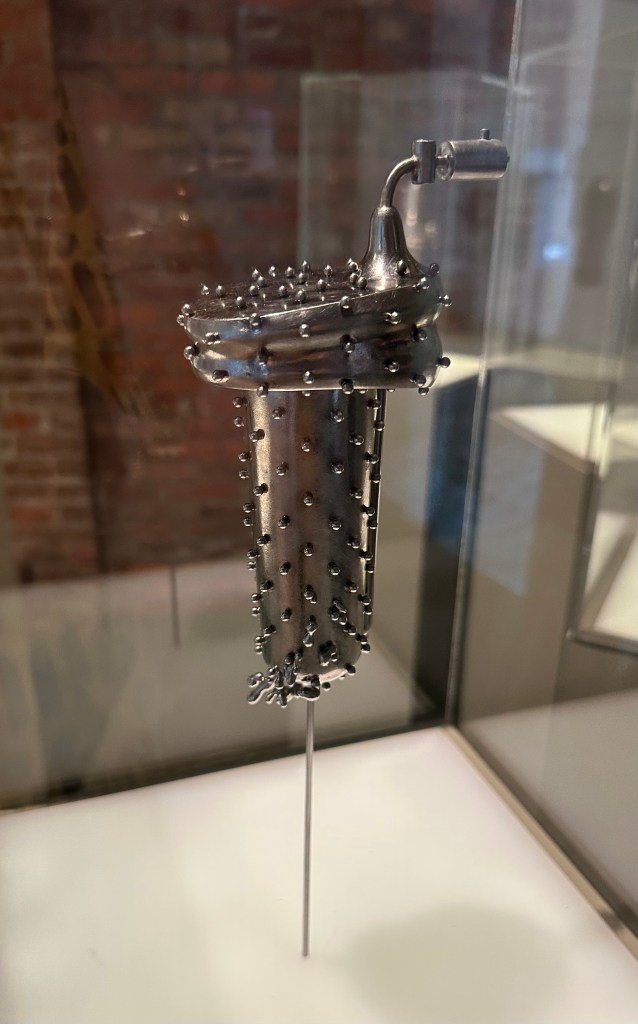
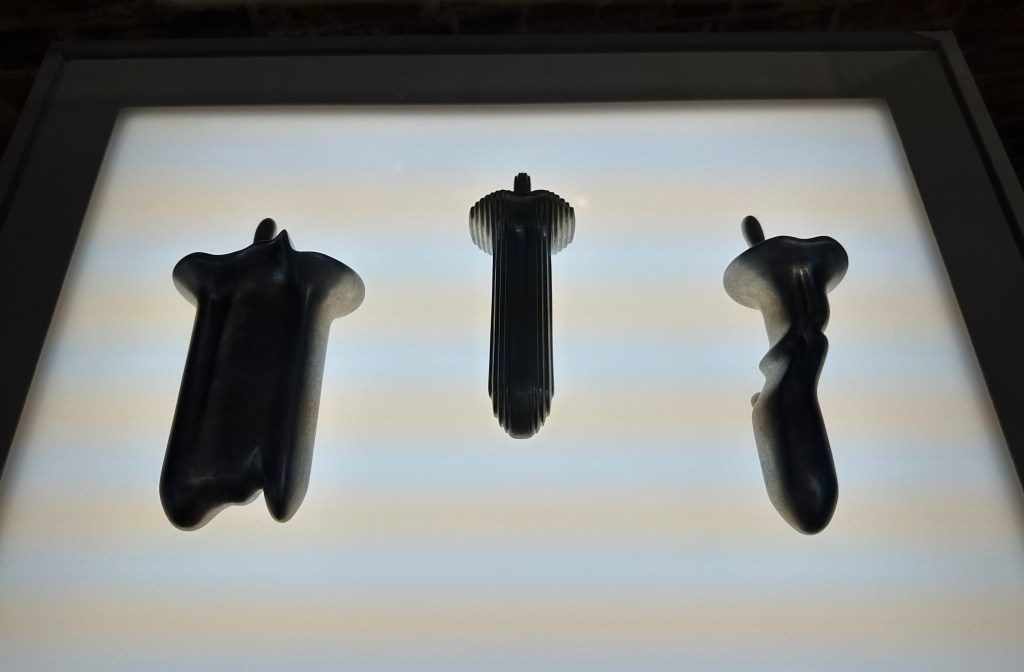
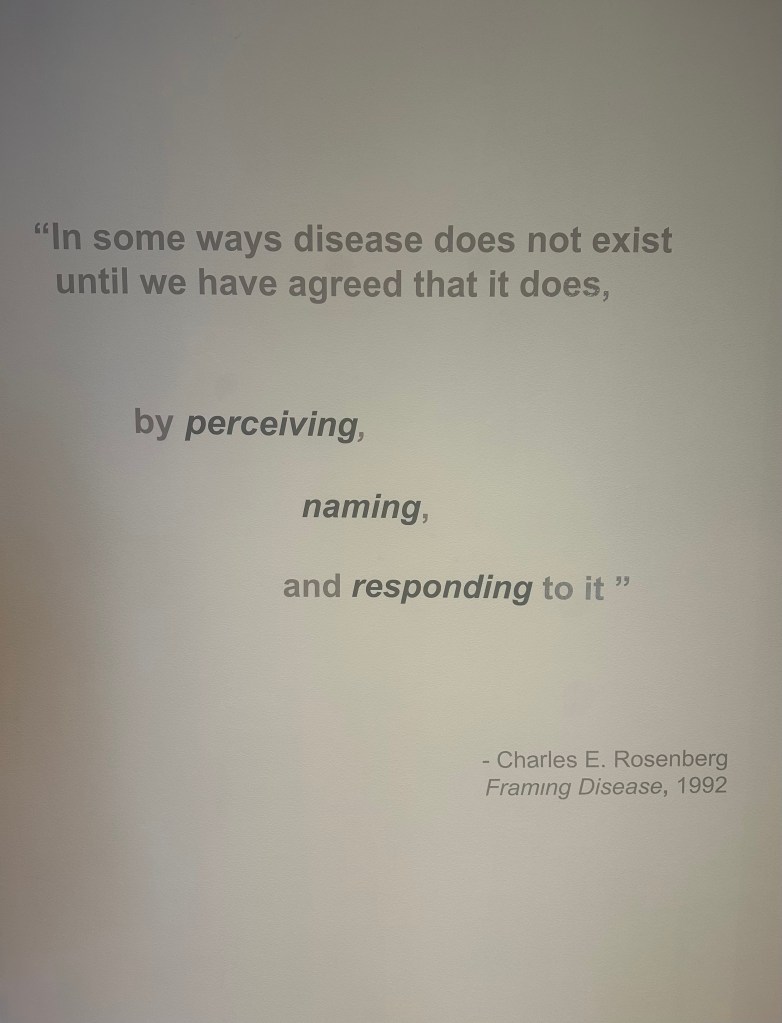
Culver’s other works are cordoned off by two long drapes that match the sickly green of the SOMSO Modelle, pooling on the floor and conjuring a small, dark corridor in the middle. The corridor is tight, silent, pleated. Moving through it feels invasive, as if we are penetrating the folds of a bodily cavity that resists our passage. Upon emerging from the corridor, we are met with a circular display of several white columns with more clear display cases on top. Inside of each is a piece from Culver’s Vestige of the Decline series. These works resist easy recognition; the shapes alone don’t immediately reveal the nature of these pieces. Within the realm of biology, a vestige is a feature that outlasts evolution, even as the function of the structure itself loses value. Are these reimagined body parts? Or repurposed medical instruments? Regardless, these forms openly defy and resist holotyping and raise the question: what is worth remembering, and who gets to decide? A quote is pasted along the side wall: “In some ways disease does not exist until we have agreed that it does, by perceiving, naming, and responding to it.” —Charles E. Rosenberg, Framing Disease, 1992.”
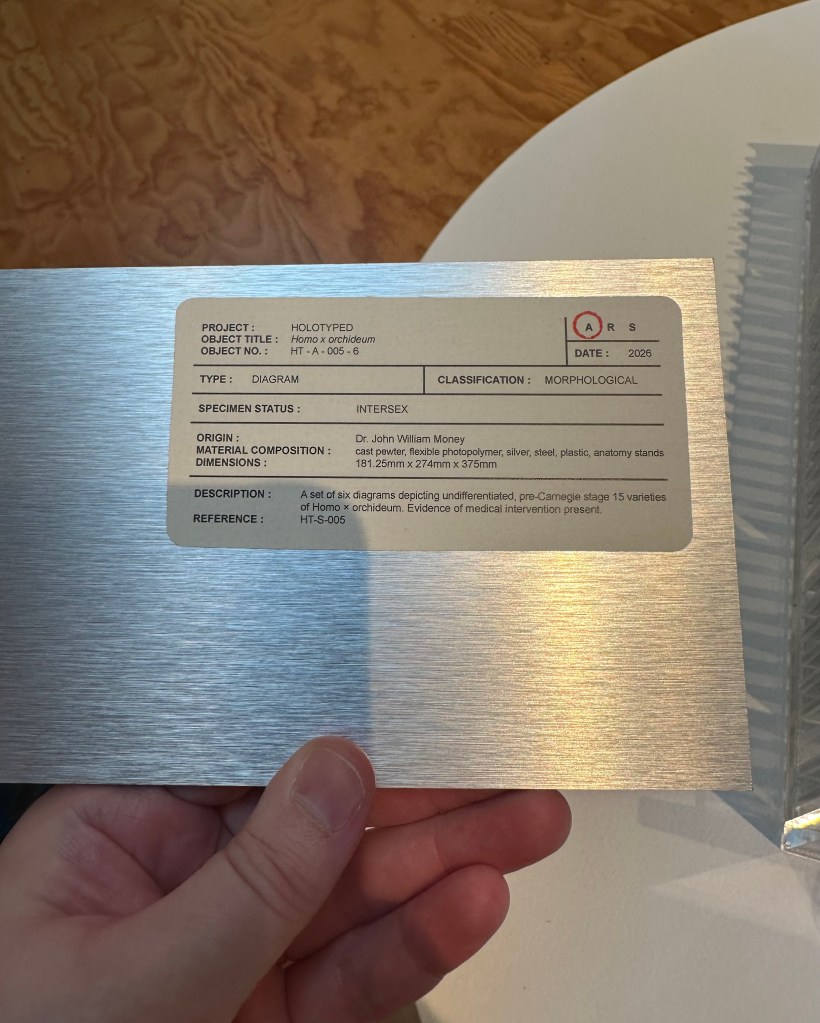
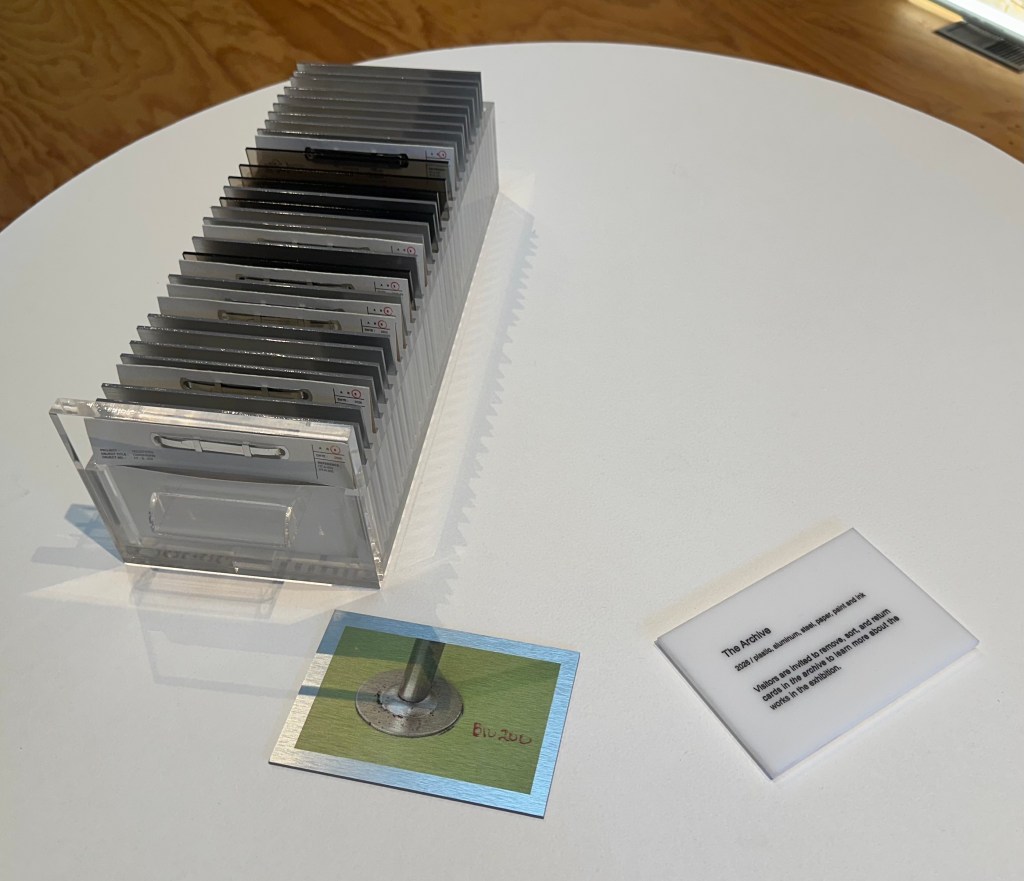
Back at the gallery’s threshold, we encounter Culver’s final provocation—The Archive. The piece itself is deceptively straightforward: a clear acrylic bin containing a mix of metal and plastic slides serving as an index for the exhibit. The placard next to the bin reads, “Visitors are invited to remove, sort, and return cards in the archive to learn more about the works in the exhibition.” The slides provide more information on items in the show, as well as real-life medical objects, ideas, and history referenced by the artist. Every slide pairs with a corresponding note card interspersed in the bin. These note cards offer additional context for the exhibit and pose thoughtful questions for viewers to consider.
By inviting us to observe her pieces and engage with her archive, Culver renders us the observed. We become the object of the gaze, our interactions with The Archive a performance, our histories documented on little cards and slides that mirror our experiences and reflect our identities back to us. The Archive is both a bold indictment of medical violence and trauma and a cheeky send-up of surveillance culture. There’s self-monitoring happening here—notably in a gallery filled with display cases that distinguish public space from untouchable elements, cases that separate us from the art itself, what makes this piece different? Are we really allowed to touch the art, to physically examine and interact with the piece? Culver is a trickster who knows precisely what she’s doing.
Culver executes a theoretical autopsy on the categories that bind us, her tools the questions she has summoned about hybridity, difference, authority, memory, intimacy, care ethics, and the nature and function of the archive. Her work evokes tension, discomfort, and disquieting unease. She invites us to engage in a thought experiment, to imagine a novel body politic, a corporeal framework in which bodily experiences are redefined and reinscribed rather than restrained, restricted, repressed. But isn’t this redefinition susceptible to re-appropriation by the dominant gaze too?
Through Holotyped, Culver generates a revolving temporal door, firmly planting one foot in archival history, the other reaching out toward speculative futures. Ultimately, though, we cannot distance ourselves from the stakes and implications of the works on display here in our current sociopolitical climate. By the time we exit the exhibit, Culver’s insinuation lands; we are already in here somewhere. We just haven’t been captured and filed away. Yet.
Emily Culver: Holotyped runs September 4 – October 31, 2026 at the Sculpture Center in Cleveland (12210 Euclid Ave Cleveland, OH 44106).
M. Dillie is a psychotherapist in the greater Pittsburgh area.
Order Petrichor’s very first print issue or subscribe for four issues a year.
Sponsored by the Pittsburgh Opera, Kelly Strayhorn Theatre, and the Pittsburgh Vintage Mixer.





Leave a Reply