by Hanna Webster
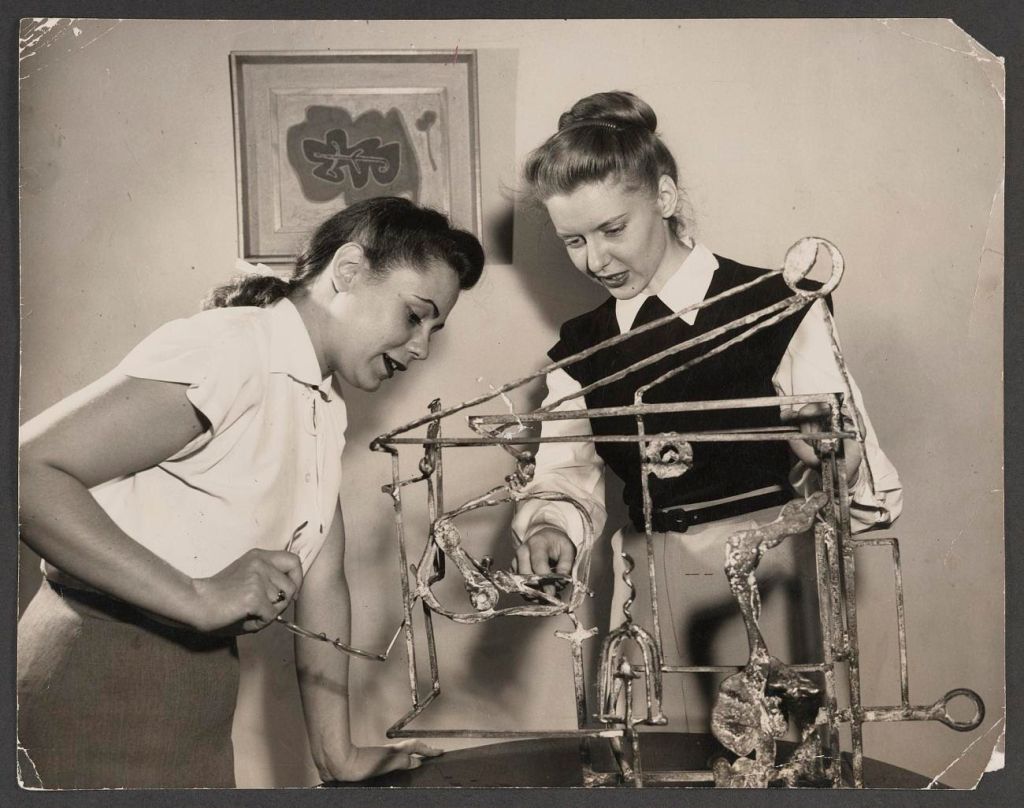
Cover image: Gallerist Elizabeth Rockwell. Image courtesy of the Archives of American Art at the Smithsonian. Used with permission.
The sun blotted tangerine by a sheen of wildfire smoke outside Romance Gallery in Oakland this past July, I was reminded a bit of what Pittsburgh must have been like in the 1940s.
Just as smog muddied the air and a war rippled through Europe then, the U.S. was bombing Iran as visitors filed into the gallery and removed their masks. One could sense the taut cord of that tension, the questions that consumed our minds’ silence, the anxieties we were reluctant to verbalize: Would every summer be like this now? Are we still allowed to enjoy art?
Romance Gallery’s exhibition that evening, Things to Come: OUTLINES, addresses those fears. As art is often a reflection of the current moment, and as generations and their powers fluctuate, it felt as if we were returning someplace familiar, our anxieties transformed into something tangible and kaleidoscopic, warped so they didn’t read so much as anxieties but a mirroring of them. Something we could face.
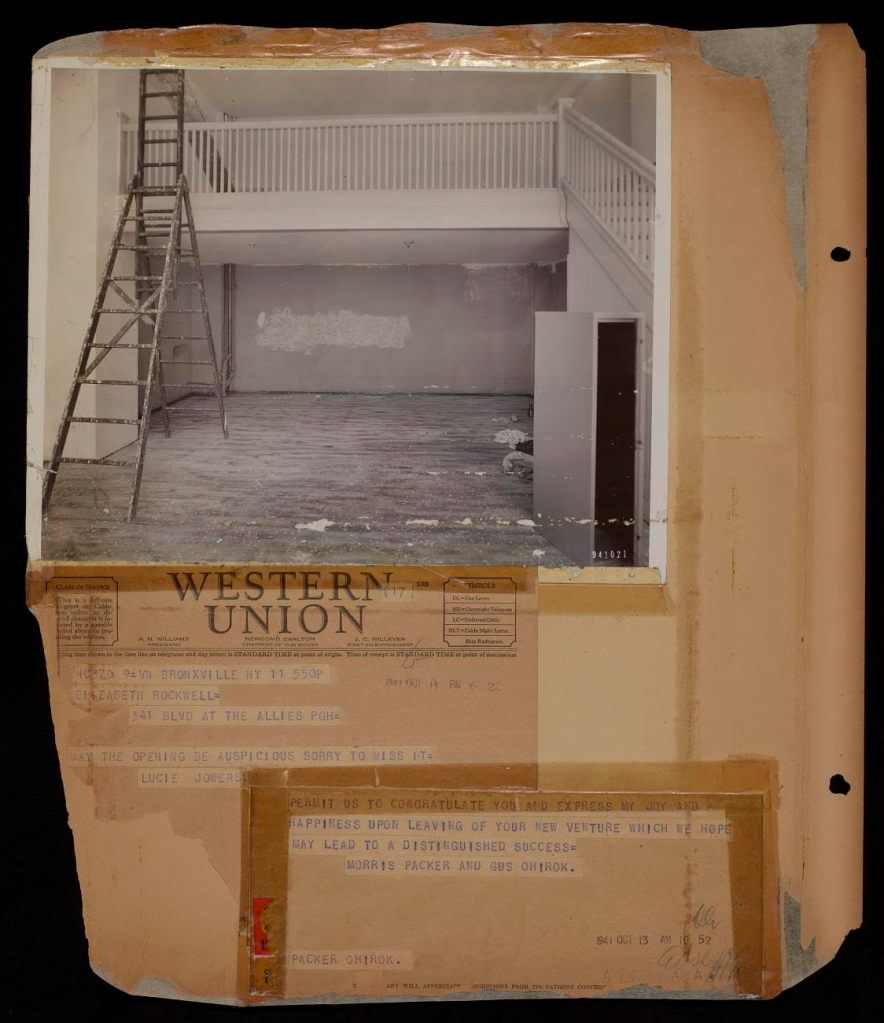
The exhibition resurrected relics of Pittsburgh’s OUTLINES, an art gallery and performance space founded by Elizabeth Rockwell at age 21 as a home for modernist art, a haven for overlooked artists, and a watering hole for the young people of an industrialist era.
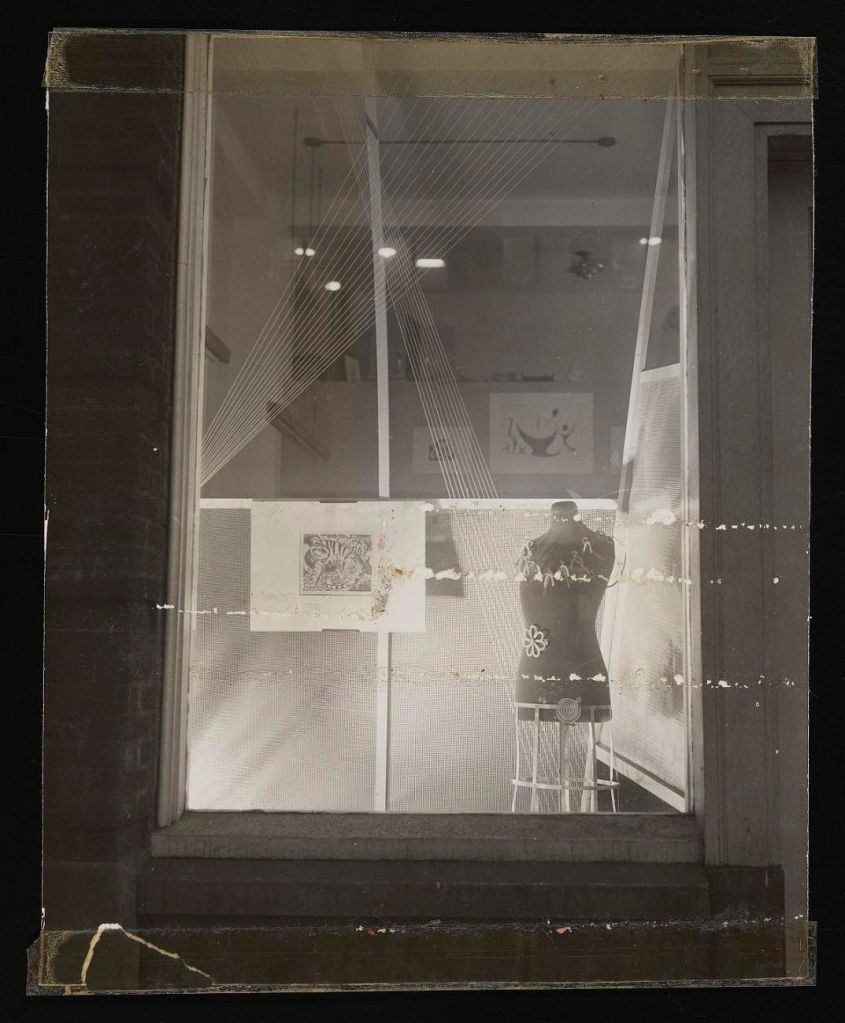
Described by Rockwell as a “public-gallery-library-theater of modern art,” the current homage maintained her interdisciplinary vision, showcasing Frank Gehry’s cardboard contour lounge chair, an old television in the corner with a short film on a loop, modernist paintings, an absurdist video of The Price is Right contestants on a portable DVD player, with all other people edited out, old newspaper clippings of OUTLINES and archival jewelry, ceramic work from her project “The Store for Arts Crafts and People-Made Things,” which was located in Verona, Pa. from 1971 to 1981.
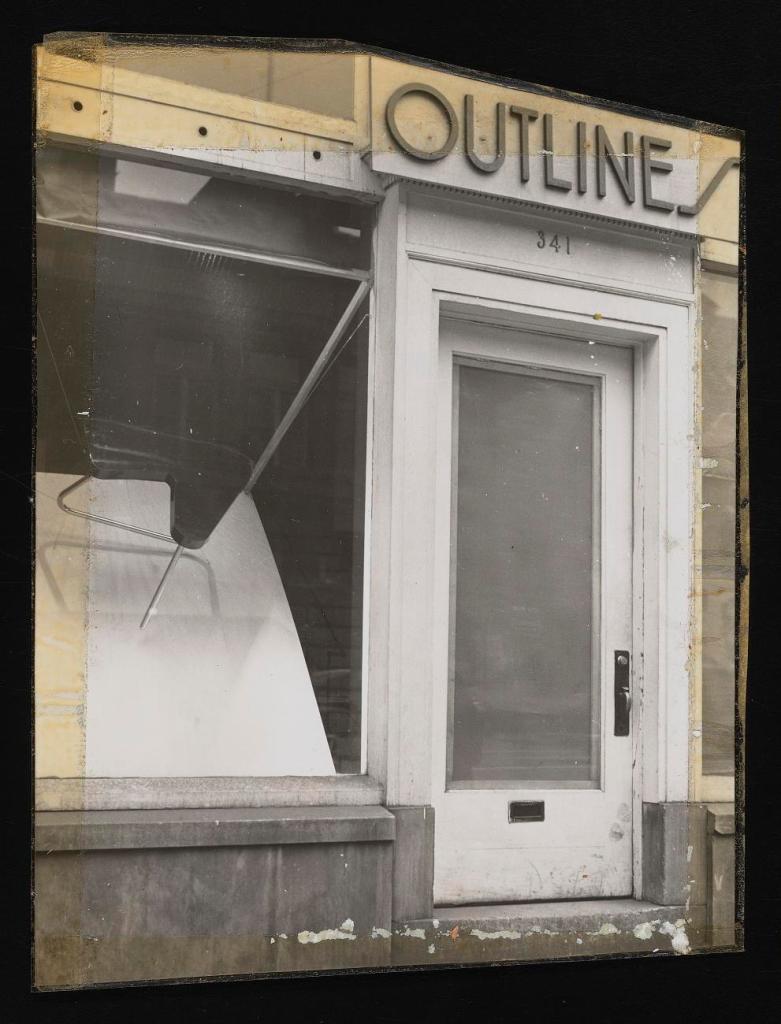
OUTLINES ran from 1941 to 1947, after which Rockwell closed it down, citing cost of upkeep and her pregnancy. At that time, Pittsburgh was ramping up its steel production for the war effort, ultimately supplying more than 100,000 propeller blades, and more than half of the gun tubes, and ninety-five million tons of steel, the weight of fifteen Great Pyramids of Giza. The University of Pittsburgh mobilized its vigorous youth to join the effort as thousands of students and staff were deployed.
“There are parallels to that moment and our moment today.”
“World War II was always in the backdrop of what [Rockwell] was doing,” said Margaret Kross, owner of Romance Gallery and co-curator of Things to Come. “There are parallels to that moment and our moment today.”
Some resisted the war’s brutality: In 1942, the Double V campaign bloomed from a Letter to the Editor in the Pittsburgh Courier, as more young men opposed the plight of war. These confluences spurned an attitude of hopelessness, of confusion and grief that, as the zeitgeist tends to do, bled into the art.
Rockwell came from a prominent family. Her father started Rockwell International, a manufacturing and defense contracting company, but OUTLINES was her vision. Although she was associated with her family’s wealth, she had taste—something money can’t buy.
“Really, she was a self-driven, trailblazing young woman thinking about curation ahead of her time. She wanted multifaceted formats for how avant-garde art was being shared.”
“Really, she was a self-driven, trailblazing young woman thinking about curation ahead of her time,” said Brittany Reilly, co-curator of the exhibit. “She wanted multifaceted formats for how avant-garde art was being shared.”
In a nondescript building off of Boulevard of the Allies in Downtown Pittsburgh, OUTLINES was a hub for intellectualism, absurdism, and interpretation of uncertain surroundings, with films, dances, lectures, and exhibits: such as Pittsburgh at War by German printmaker and sculptor Kathe Kollwitz and an Artists in Wartime exhibition.
Rockwell became interested in painting after attending Sarah Lawrence College, and she brought her interest back to Pittsburgh. In a 1984 interview with her friend Florence Rosner, Rockwell said she had her eye on Pittsburgh because, well, it was better than New York as a home for modernism (tourists, take notes).
“I didn’t want to stay in New York as I felt it was too cloistered an atmosphere,” she told Rosner. “It was too easy to be complimented on what you were trying to do in New York … I didn’t know if Pittsburgh would be a good place for new art, but I felt it was the only alternative for me. It never occurred to me to try anywhere else in the country.”
While her family was going to the symphony, she was showing the 1924 Dadaist film “Ballet Mécanique,” an early example of montage in visual media. She was exhibiting American architect Paul Nelson’s suspended houses project, which envisioned utopian communal living as art. She showcased European modernists unknown to many Americans, as well as some figures now considered legendary artists: Langston Hughes, John Cage, Charles Eames.
“The gallery was interested in giving visibility to artists who haven’t had it in new ways,” said Kross.
Romance Gallery exists in its own kind of liminal space, inside a converted medical office in an unassuming building off Craig Street in Oakland. Visitors can stand inside what would be the receptionist area, peering over a wide counter where one might sign a consent-to-be-treated form, and into the main gallery room. The converted space hints at the same themes of reinterpretation and transformation of the exhibit—how Rockwell was evolving the lens of modernist art as she was showing it.
Currency is a recurring motif in this show. In addition to showing artists Rockwell exhibited at OUTLINES original, Things to Come interspersed a few modern works of similar ambiance. French artist Hélène Yamba-Guimbi’s Penny Machine, made this year, is a clear box filled with beads, lucky tokens, chocolate coins, and pennies. I gazed into the machine on the ground, which wasn’t higher than my knees. Inscribed on one coin: god be with you, til we meet again, and on a 2024 coin: Take America back.
The main room also showed Brianna Perry’s 60 cents, a small 6×9 work of checkered fabric stretched out over three coins. It called to mind the strategy and inequity of wealth—not only wealth, but the achievement of a living wage in America. The artifice of promise, the guarantee of stability—it must have felt true then, in 1944, and inside Romance Gallery this summer, it certainly felt true.
Flip 180 degrees from 60 cents and you’d see its spiritual opposite, a four-foot 1950’s painting by Pittsburgh-based artist Louise Pershing, called inner bound. The painting depicts a white circle sliced in half on a black background, a small circle wedged between the halves, like a pinball stuck in a vice. Is that not how it feels right now, the pressure to make something meaningful while we get push alerts about air strikes?
Pershing may have been reflecting on Pittsburgh’s landscape, disquieted about the evolving industrial world. One can relate. That cyclical universality is part of what allowed Things to Come to feel so current, and so validating. We’re not alone in our existentialism about a society increasingly reliant on technology, and we’re not always wrong to fear the double-sided edge of innovation.
I glanced up from the Gehry contour chair at a sun dipping below buildings’ horizon and the neon lights of the 7/11 gas station, smoke still lingering.
Things to Come: OUTLINES 1941–1947 was a project of Margaret Kross (Romance Gallery) and Brittany Reilly (Pittsburgh Modernists, the Aaronel deRoy Gruber foundation). The gallery series had the following sections:
i. Meshes and Designs
ii. Archive Theater
iii. “The Store for Art in Craft and People-Made Things”
iv. Aftersounds (Lectures and Programs)
Work featured was by: Anni Albers, Alexander Calder, Joseph Cornell, Maya Deren, Gertrude Glass Greene, Max Guy, Paul Mayén, Peter Müller-Munk, Isamu Noguchi, Irene Rice Pereira, Jens Risom, Arthur “Art” Smith, Harrison Kinnane Smith, Emilia Wang, Eva Zeisel, and others.
The program ran March 20–August 29, 2026.
–
Hanna Webster is an award-winning journalist and poet with an MA from Johns Hopkins University. She is a Pulitzer grant recipient, and her art, essays, and poems have appeared in Poynter, Popular Mechanics, Bellingham Review, Stonecoast Review, HAD, Epiphany Magazine and elsewhere. She lives in Pittsburgh, Pennsylvania.
–

Order Petrichor’s very first print issue or subscribe for four issues a year.
Sponsored by the Pittsburgh Opera, Kelly Strayhorn Theatre, and the Pittsburgh Vintage Mixer.





Leave a Reply