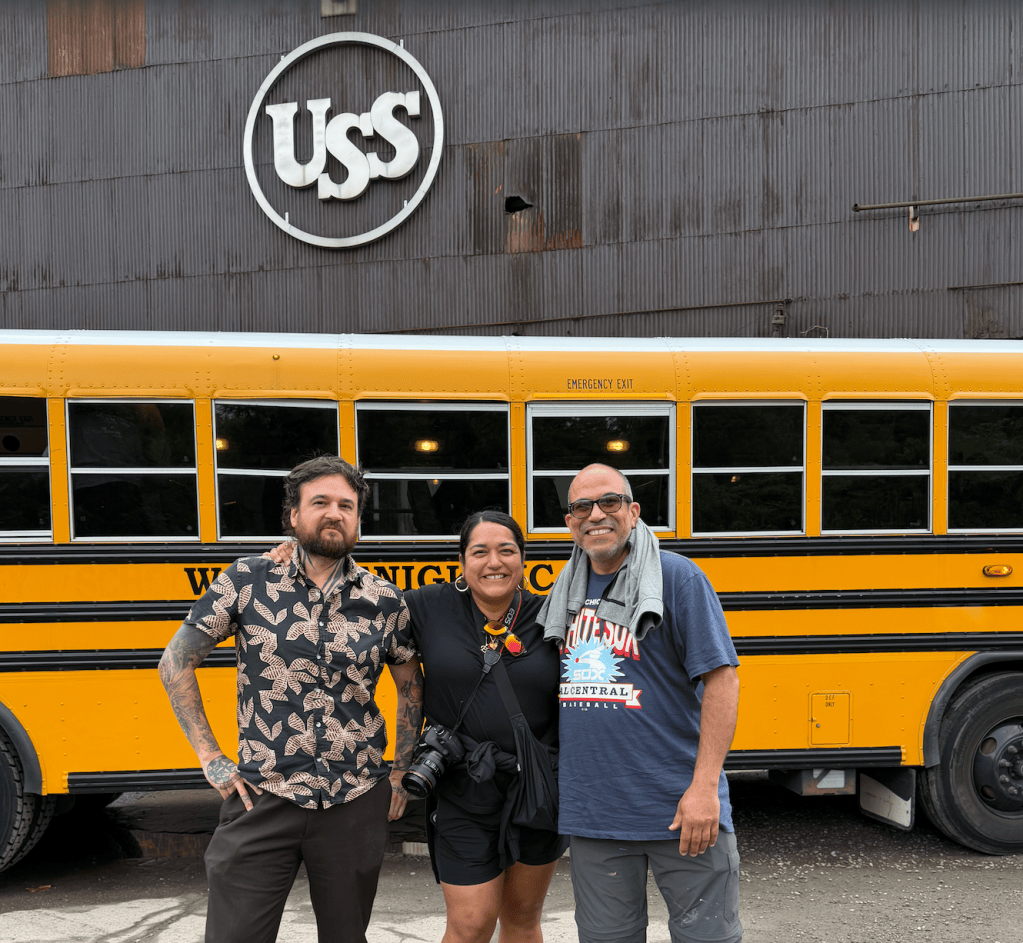
by Grace Marcy Lucas and Mollie Young
A mural is never just an image on a wall. It is also a claim to space, a record of who was there and a way of deciding what deserves to be remembered.
For ten days this September, three artists from across the Americas brought their own interpretations of that claim to Pittsburgh. Tomas Ives, Gloria “Gloe” Talamantes and Ish Muhammed arrived for the Hemispheric Conversations Urban Art Project’s (HCUAP) 10th annual visiting artist residency, leaving new murals in Garfield and at the Carrie Furnaces. Their work emerged from a shared prompt: Our Americas.
Timed to coincide with America’s 250th anniversary commemorations, the theme calls into question what it means to be American, and who gets to make that meaning. Across the Americas, borders are drawn not only on maps but through histories of migration, labor, identity and belonging. Public art offers a way to trace and challenge those boundaries.
The question has particular resonance in Pittsburgh, where industrial history is written into the landscape and graffiti has long existed in tension with the city’s approach to public space. Founded a decade ago by Dr. Caitlin Bruce, Shane Pilster and Oreen Cohen, and now joined by Emma Riva and Max Gonzales, HCUAP creates opportunities for conversation and education around urban art production. Its visiting artist residency extends that work by bringing artists into dialogue with the places and people that shape Pittsburgh.
Over the course of their visit, Ives, Talamantes and Muhammed encountered a city whose stories were already inscribed on its walls, in its industrial ruins and across its neighborhoods. Their task was not simply to add three more murals, but to interpret what they found—and to leave something of their own behind.
The residency began at Slanted and Enchanted in Garfield, where an opening exhibition brought together work by local artists and prints by the visiting artists. Over the following days, the group moved through Pittsburgh and its surrounding region, encountering different layers of the area’s artistic and industrial history.
At the Carrie Furnaces,, a former industrial site that would become the setting for Gloe’s mural, the artists encountered the physical remnants of Pittsburgh’s industrial past. In Millvale, a tour of the Vanka Murals presented historic religious and political paintings whose imagery continues to carry meaning across generations. Further south, at the Ruins Project in Fayette County, an outdoor mosaic museum on the site of the former Banning No. 2 coal mine brought art into conversation with another industrial landscape.
These encounters offered more than an introduction to the region. They gave the artists a chance to consider how images become embedded in a place and how art can preserve, reinterpret or challenge the stories that place tells about itself.
For Muhammed, Our Americas is a commentary as to who decides what it really means to be “America” in 2026. His mural, “What We Carry,” located in Garfield, uses a geometric blend of shades of red, white, and blue to take ownership over these colors as a member of the LatinX community.
Muhammed wants people who pass by his mural to know that “whatever you see and whatever you feel like you’re carrying– you’re right.”
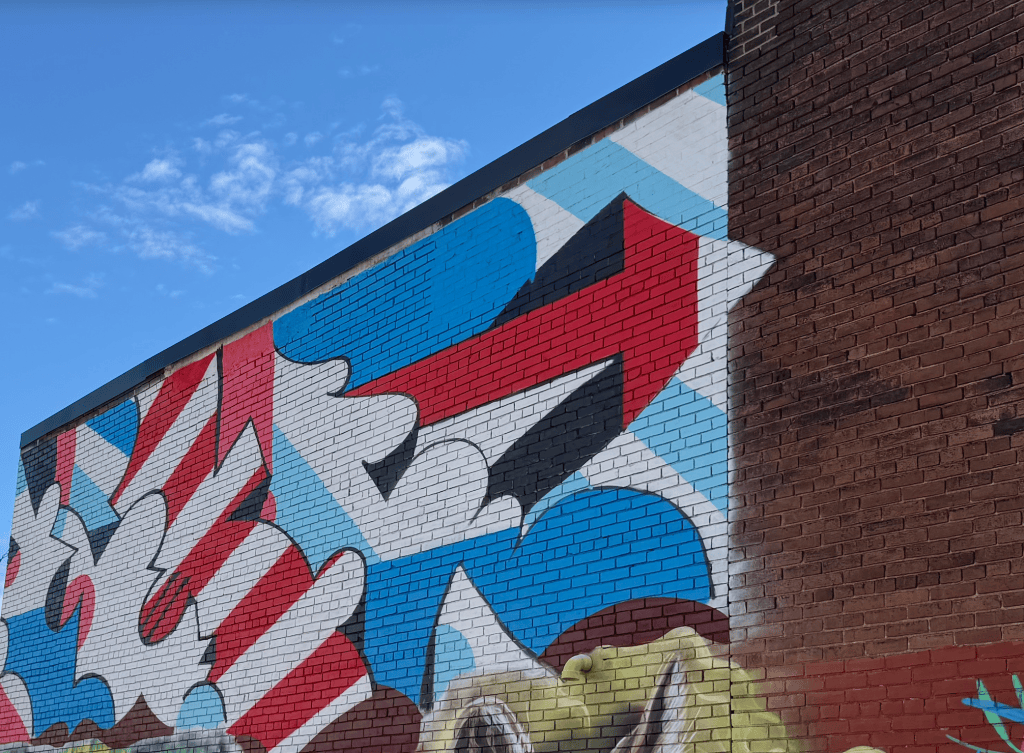
“Whatever you see and whatever you feel like you’re carrying–you’re right.”
Just on the other side of Muhammed’s mural, Ives brings his classic surrealist, figurative landscape style with a Pittsburgh twist to Garfield. Where Muhammed’s mural asks who gets to claim the American identity, Ives approaches the question with attention to the landscapes and histories that shape the Americas.
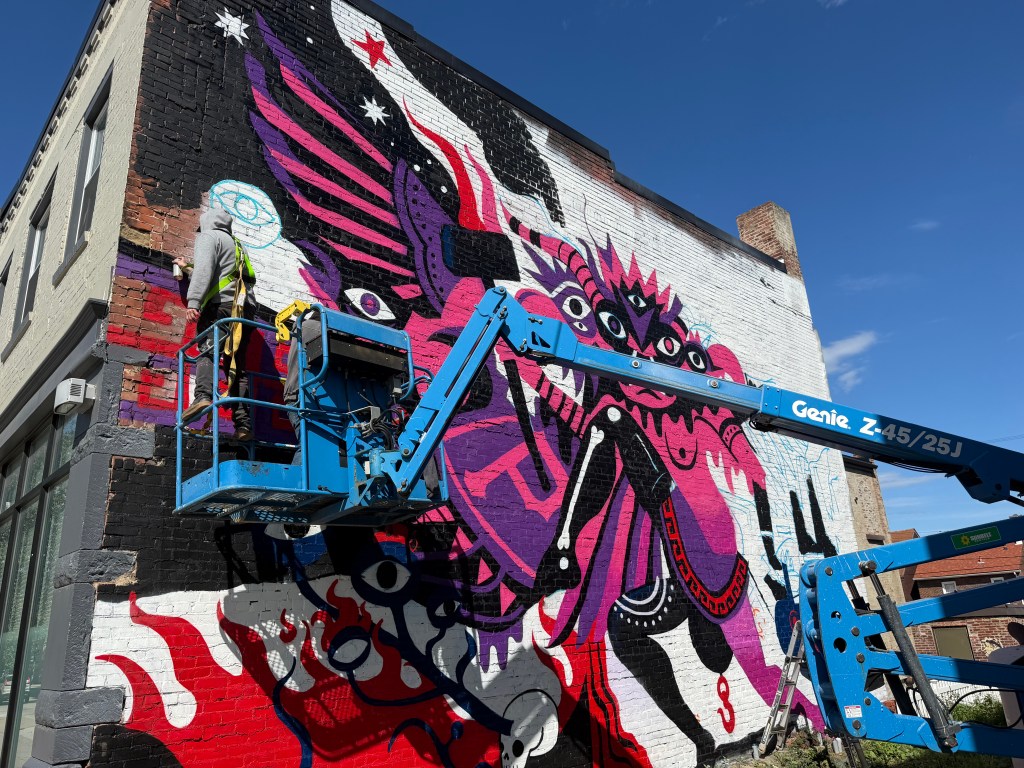
“Images don’t represent worlds, they help us build them.”
Ives’ practice is rooted in his belief that “images don’t represent worlds, they help us build them.” This belief comes to fruition on his mural in Garfield, “Dialectic Demon,” which serves to bring together the rich industrial history and future of educational and technological advancement of Pittsburgh together in one scene.
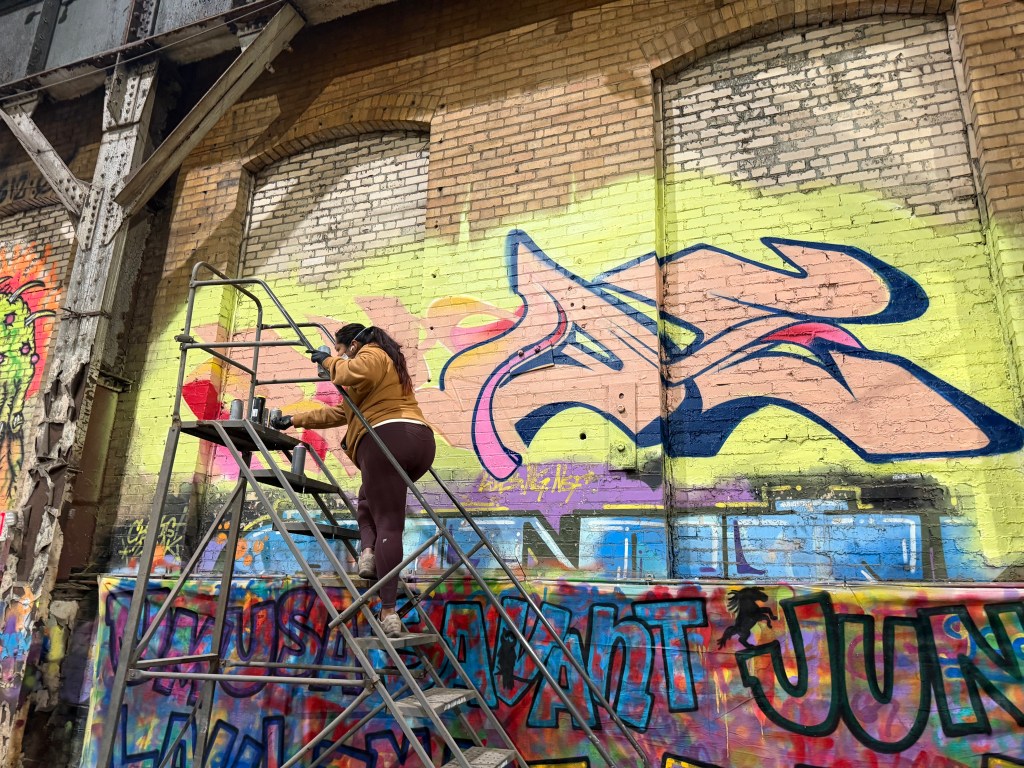
If Ives considers how images shape the worlds we inhabit, Talamantes’ practice expands that idea beyond the finished mural, treating the process of making art as a way to build relationships.
Talamates, who started with graffiti when she was a teenager, credits it for saving her life. She stresses how art can help individuals heal and understand systematic traumas.
Her practice in Pittsburgh was no different. Talamantes hosted a workshop at Assemble in Garfield, where Pittsburgh public school kids assisted her on their day off. Using leaves she found on her walk, she had everyone observe their leaves, stamping them to observe their texture. The exercise reflected an approach to art that begins with observation and shared experience, rather than imposing an image on a space.
Talamantes described her experience creating her mural Untitled… as very nostalgic– enjoying going back to graffiti writing and spray paint. Her response to Our Americas can be seen through her approach to her work, emphasizing collaboration, consideration for spaces, people, histories, forgotten and told all surface in her work. The American identity, to her, is a healing one. One that is growing out of community support.
The murals were only one part of the residency. Just as important were the conversations, workshops and collaborations that brought the visiting artists into contact with Pittsburgh’s own creative communities.
The residency’s final days extended the artists’ conversations with Pittsburgh beyond the walls they had painted. At the Andy Warhol Museum, Ives, Talamantes and Muhammed spoke about their backgrounds and experiences in the city, reflecting on the relationships they had built with local artists. The discussion also turned toward the collaborative work surrounding the repainting of Strawberry Way.
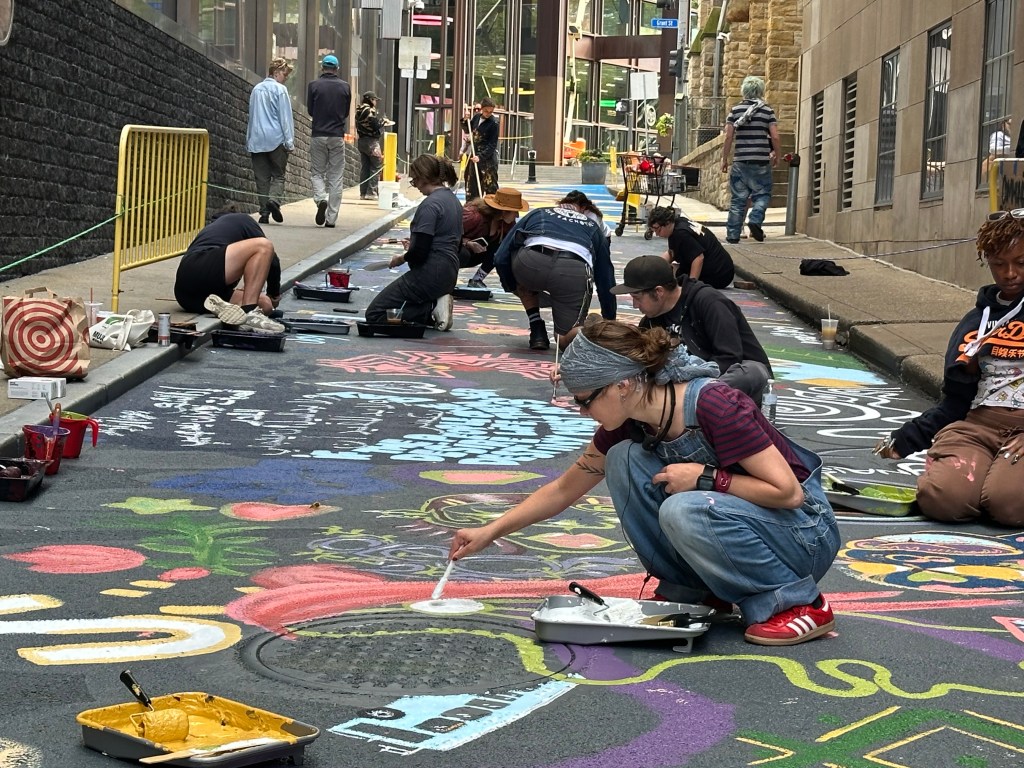
Through a community paint jam organized with the Pittsburgh Downtown Partnership, Strawberry Way became a space where residents could participate in public art rather than encounter it only as spectators. Artists, members of Pittsburgh’s creative community and passersby were invited into the process itself.
For Talamantes, that kind of exchange is central to HCUAP’s purpose. She described the project as an “institution of liberating information,” emphasizing the value of creating opportunities for people to share knowledge, encounter new perspectives and continue making art together.
For Talamantes, that kind of exchange is central to HCUAP’s purpose. She described the project as an “institution of liberating information,” emphasizing the value of creating opportunities for people to share knowledge, encounter new perspectives and continue making art together.
The murals left behind by the residency are now part of Pittsburgh’s visual landscape. But the project’s legacy extends beyond the images themselves, into the relationships formed, the conversations opened and the people invited to imagine what their shared spaces might become.
–
HCUAP would like to thank the Andy Warhol Foundation for the Visual Arts for major funding, the Dietrich School of Arts and Sciences Dean’s office. HCUAP received funding from Pennsylvania Creative Industries, powered by the Pennsylvania Council on the Arts, a state agency funded by the Commonwealth of Pennsylvania and the National Endowment for the Arts. This project is supported in part by the Greater Pittsburgh Arts Council through its Creative Sector Flex Fund grant program. Thanks to Duolingo for sponsorship, and the Bernadette Callery Archives Lecture Series at the University of Pittsburgh. Housing provided by Pedantic Arts Residency; paint sponsorship by Aerosol Legends/NBQ Pro Spray Paint and Sherwin Williams Paint and BLICK Art Materials for art supplies donation. The Strawberry Way Paint Jam is made possible by the Pittsburgh Downtown Partnership.
—
Grace Marcy Lucas is a senior at the University of Pittsburgh. She studies Communications, Political Science, as well as Gender, Sexuality, and Women’s studies. Grace aspires to combine her passion for the arts with her communication studies and writing experience.
Mollie Young is a senior Communication Rhetoric and International Studies major at the University of Pittsburgh. Her academic interests center on how communication, culture, and storytelling shape public understanding and community identity. Through her work in strategic communications and community-based arts initiatives, she explores how public art expresses cultural identity, preserves collective memory, and fosters dialogue across communities. She hopes to carry these interests into a future career in global policy.
Order Petrichor’s very first print issue or subscribe for four issues a year.
Sponsored by the Pittsburgh Opera, Kelly Strayhorn Theatre, and the Pittsburgh Vintage Mixer.





Leave a Reply