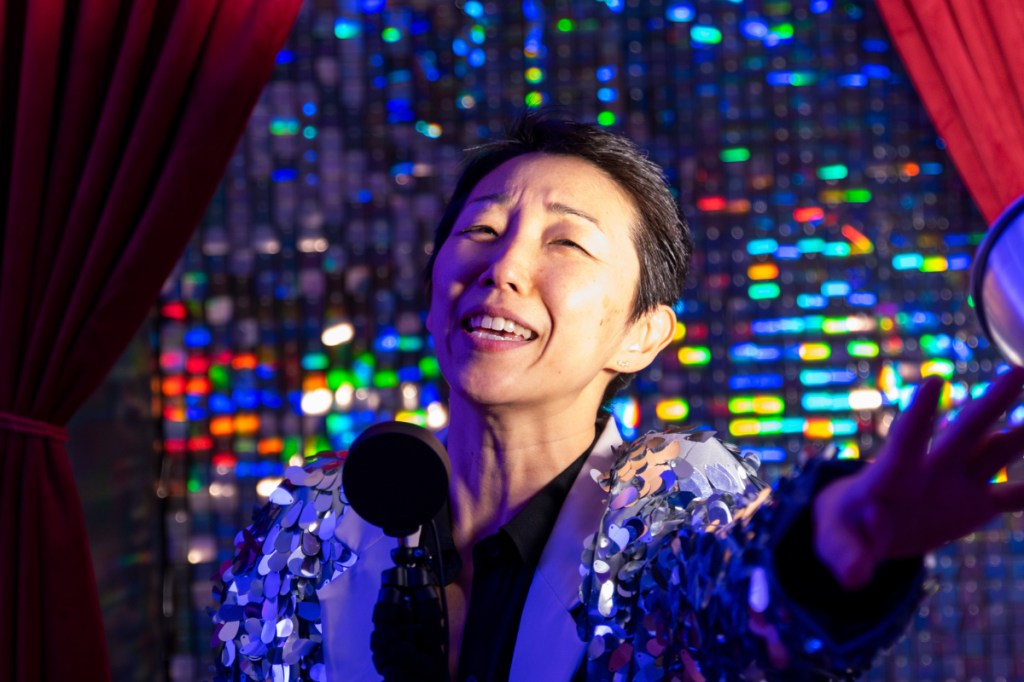
Interview by Emma Riva
Kelly Strayhorn Theatre has partnered with Petrichor to sponsor fall articles, so the below interview is part of a sponsored package.
Can karaoke be a form of healing?
Maree ReMalia had a lifelong fear of public speaking, but after her father’s death and the chaos of the COVID-19 pandemic, she found herself wanting to use a microphone. Those feelings come out in With Ourselves, With Each Other, a performance debuting at Kelly Strayhorn Theater this Friday, October 23. ReMalia is a former ballerina and experimental dance-maker, so there are elements of movement and dance in the piece, but it’s part storytelling, part song, and all the complex experience of being alive.
ReMalia spoke to us about her process, working with Pittsburgh arts professionals like David Bernabo, Adil Mansoor, and Rona Chang of OTTO FINN, as well as the support of Hatch Arts Collective. In With Ourselves, With Each Other, ReMalia explores the idea of the “primal wound” she felt as a Korean adoptee and how movement and music have helped her self-expression. Pain and grief are one of the few truly universal emotions, yet we lack the language to talk about them. With Ourselves, With Each Other shows one way to honor those experiences.
Petrichor: What was the inspiration for the title?
Maree Remalia: The title of WITH OURSELVES, WITH EACH OTHER (WOWEO) arose from a desire to explore how we connect meaningfully with ourselves and one another while moving through complex experiences. How do we process griefs both big and small, witness humor alongside hurt, and celebrate personal and collective triumphs? I’m interested in how shared rituals—whether through dancing, singing, storytelling, grieving, or celebrating—can create opportunities to witness one another, feel less alone, and practice being together in the midst of life’s complexities.
In a world that can feel turbulent and relentlessly overstimulating, I’m curious how we make space for who we are, including the histories we carry and the many, sometimes contradictory parts of ourselves. How might these moments of sharing help us soothe ourselves, build relationships, and find new pathways forward together?
“In a world that can feel turbulent and relentlessly overstimulating, I’m curious how we make space for who we are, including the histories we carry and the many, sometimes contradictory parts of ourselves. How might these moments of sharing help us soothe ourselves, build relationships, and find new pathways forward together?”
How did you and Adil Mansoor collaborate throughout the process?
MR: I first met Adil Mansoor and Joseph Hall through PearlArts Studios’ inaugural movement residency in 2013. I have deep admiration for both of them and have learned so much through our collaborations over the years. It has been a pleasure and a privilege working with Adil in many capacities over the years—as director and performer in each other’s work, as teaching artists with Dreams of Hope Queer Youth Arts, and as co-facilitators at Middlebury College. In 2022, Adil invited me to an artist retreat where the seeds of WITH OURSELVES, WITH EACH OTHER (WOWEO) began to take shape. I was so moved Adil invited me to develop this work through Hatch Arts Collective’s NEST Residency in 2024, deepening our relationship as co-directors, with Hatch as producer.
My relationship with Joseph has also been an important part of my artistic life. During his time as Producing Director at Kelly Strayhorn Theater (KST), he invited me to participate in the Fresh Works Residency. Joseph has been a performer in my previous projects and we collaborated on an evening of work featuring artists from NY, VT, PA, and South Korea, while he worked at BAAD! Bronx Academy of Art and Dance. It has been exciting to continue building our relationship, now with Joseph as KST’s Co-Executive Director.
KST has supported my work through residencies, teaching engagements, and presentations over many years. I feel a deep alignment between my artistic values and the commitments of Hatch and KST: creating space for experimentation, supporting artists who challenge conventional expectations, and expanding the voices, experiences, and ways of being that can be held in performance.
While my role has been as creator and performer, WOWEO has been shaped by Adil, our interdisciplinary artistic team, Hatch’s producing support, and KST’s partnership. The artistic team has grown as the project has evolved. The artistic team for the premiere includes Pittsburgh treasures: David Bernabo (sound design), Rona Chang/OTTO FINN (garment design), Kolton Cotton (media design), Sarah Ashley Cain (producer), Jenny Johnson (dramaturg), Katie Mikula-Wineman (props and set dressing), Sasha Jin Schwartz (scenic design), Ian Thomas (stage manager), Iliana Tomasa Sharp (assistant director), and Nicole White (lighting design). Each person has brought a distinct perspective, and their contributions have often sparked ideas and possibilities beyond their own discipline.
Adil and I work through devised and emergent processes, balancing structure with openness to what the team discovers along the way. Adil has been central in creating the framework for this process: developing short- and long-term goals, shaping rehearsal schedules and residency focuses, and helping us identify which threads to follow and what to explore next. We discuss and develop these plans together as a team. He has also been a performance coach and an artistic sounding board, helping me recognize connections within the material and bring the performance and design elements together into a cohesive whole.
In our early rehearsals, Adil invited me to share the questions, materials, and influences I was sitting with related to the work. These ranged from my relationship to voice and the death of my father to grief, remembrance, joy, and celebration—and the ways these experiences often coexist. I shared an eclectic collection of influences: performances by multidisciplinary artists such as ALOK, Laurie Anderson, Nora Chipaumire, Faye Driscoll, and Young Jean Lee; karaoke lounges, pop stars like Madonna, and indie songwriters like Ani DiFranco; poignant and hilarious comedy specials like Jerrod Carmichael’s Rothaniel and Hannah Gadsby’s Nanette; the documentary Between Goodbyes; and the work of writers and reporters such as Andrea Gibson, Prentis Hemphill, and Anderson Cooper’s “All There Is” podcast.
I also drew from movement practices across dance and theater, as well as the curiosity-driven, nonlinear approaches and community focus of my mentors Bebe Miller, Delisa Myles, and Liz Faller. Alongside this research, boxing lessons, aqua cardio, and dance classes spanning ballet, contemporary, and hip hop informed my physical training for the work. Rather than beginning with a fixed narrative, we used these materials and experiences as points of departure for collective exploration.
“As the process unfolded, my experience as a Korean adoptee became more present in the work. During our second residency, archival images from my adoption journey and dance history became part of our generative material. We experimented with movement, text, and song, sometimes beginning with prompts from the team and sometimes letting movement lead us toward words or music.”
As the process unfolded, my experience as a Korean adoptee became more present in the work. During our second residency, archival images from my adoption journey and dance history became part of our generative material. We experimented with movement, text, and song, sometimes beginning with prompts from the team and sometimes letting movement lead us toward words or music. Karaoke workshops and vocal lessons opened up new ways for me to explore singing and using my voice.
Because the piece draws on my personal experiences, Adil, dramaturg Jenny Johnson, and assistant director Iliana Tomasa Sharp have been key collaborators in shaping its narrative arc and threading its themes together. Their attention to storytelling complements my own more intuitive, embodied sense of an arc—what I sometimes jokingly call “just vibes.” The exchange between these approaches has helped me discover connections in my own material that I might not have found working alone.
Some of the most meaningful developments have come from the ways individual contributions have sparked new directions. Adil has been instrumental in developing the individual threads of the work and finding ways to weave them together into a cohesive whole. After experiencing my facilitation of a movement experience, Jenny developed writing prompts that helped me create a guided experience I now invite audiences into. As we explored grief and my dad’s love of fishing and being on the lake, David created an ambient soundscape we call “Grief Dance,” with textures that evoke foghorns for me. Kolton led collage-making explorations using archival images from my life; these informed the performance’s visual imagery and also shaped activities in our community workshops. Sasha has created a remembrance altar for each iteration and facilitated part of a community workshop around this practice, helping us consider how remembrance might extend beyond the performance itself.
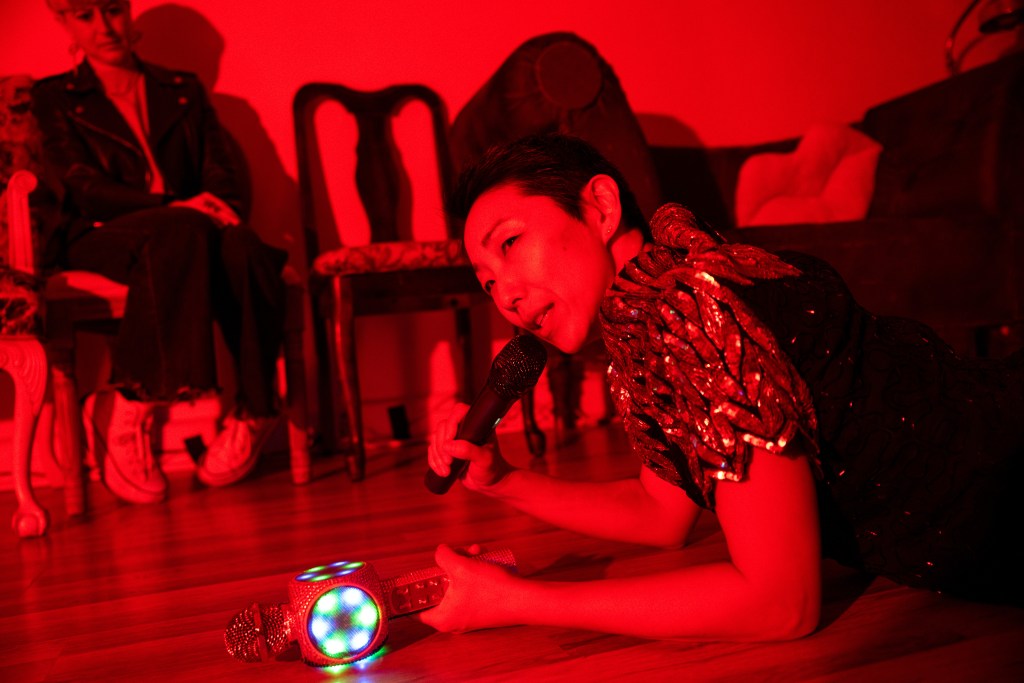
As the adoption story became more central, we began working more closely with Rona on a garment that is a contemporary design drawing from Korean traditional clothing. Nicole shifts our sense of intimacy and scale through lighting that moves between the atmospheres of disco and funeral. Katie helped source a bench during our early development that became the starting point for a key scenic element, gradually taking on personal significance as the work evolved. More recently, Ian and Sarah have joined the team, helping coordinate the many moving pieces of production as we prepare for the premiere. These are just a few examples of how the team’s ideas, care, and labor have become woven into the fabric of the piece.
Because I’m based in Tulsa, Oklahoma, we’ve worked together in person through four intensive residencies, connecting remotely and working independently in between. That rhythm has given me time to write and do movement research on my own, informed by our shared explorations as well as my own experiences and discoveries between gatherings. We’ve also had the opportunity to try the work in a variety of spaces, from an intimate multimedia room to a black box theater and studio showing. Each configuration has prompted us to reconsider how audiences might be gently invited into the experience. For the KST premiere, with the audience sharing the stage with me, I’m discovering new possibilities for moving among them. Having time and space for ideas to simmer, shift, and grow has been essential. Through these exchanges between movement, storytelling, sound, imagery, design, and space, we’ve built the world of “karaoke-funeral-lounge”—something far beyond what I could have imagined on my own.
“Through these exchanges between movement, storytelling, sound, imagery, design, and space, we’ve built the world of “karaoke-funeral-lounge”—something far beyond what I could have imagined on my own.”
There has also been an enormous amount of work behind the scenes. Adil and Hatch have taken on much of the producing and administrative labor, from fundraising to coordinating developmental residencies and in-process showings. Hatch raised critical funds for the project, and we worked in partnership with KST to secure additional national funding and developmental opportunities, including support from CMU Center for New Work. Ben Pryor has generously supported grant writing and helped connect us with opportunities to share the work in development, including an in-process showing in New York. Joseph and the KST team have been important partners in supporting the premiere and envisioning accompanying community programming.
Having this kind of artistic, producing, and institutional partnership has been such a gift. It has given me more room to focus on the creative work while feeling held by a community of people who believe in it.
How does karaoke act as a framing device for the show?
MR: Like many people, I have dealt with a fear of public speaking and have always preferred expression through the moving body over the voice. The seeds of WITH OURSELVES, WITH EACH OTHER (WOWEO) grew from a desire to activate my voice in new ways and explore practices for being with grief. Around the time of the pandemic, the uprisings for racial justice following George Floyd’s murder, and the death of my father, I felt that movement alone couldn’t fully convey everything I wanted to express. I wanted to find ways to speak more clearly about my experiences and practice using my voice, even when it felt vulnerable or uncertain.
“During the creative process, I encountered the term “primal wound,” which some adoptees use to describe the lasting impacts of early separation from one’s birth mother. I began to wonder whether my longstanding fears around speaking and using my voice might be connected to that separation.”
During the creative process, I encountered the term “primal wound,” which some adoptees use to describe the lasting impacts of early separation from one’s birth mother. I began to wonder whether my longstanding fears around speaking and using my voice might be connected to that separation. Growing up, I often found that pop, rock, folk, indie, metal, and alternative music could express a range of emotions through words in ways I struggled to access myself. In WOWEO, karaoke and storytelling have become ways to explore those feelings and practice using my voice—not as something I’ve mastered, but as an ongoing process.
I love karaoke as a shared ritual of permission. It has offered me a meaningful, low-stakes way into using my voice while inviting emotional and tonal range. Regardless of how we sound, we can root for one another, sing with feeling, and make space for vulnerability. You don’t have to be a great singer to be moved by a song or move someone else. WOWEO draws on karaoke’s unapologetic spectacle, the ceremonial weight of funerals, and the intimacy of a neighborhood lounge. Unfolding like a live mixtape of confession and catharsis, the work explores how a solo body can become a gathering place and the mic a lifeline. It invites audiences to sing along, witness humor beside hurt, and inhabit their own multitudes.
I am not a trained or “good” singer. With Hatch’s support, I’ve been fortunate to work with vocal coaches and artists Jisook Kim, Kara Staiger, Micaela Tobin, and Lisa Velton Smith. Their patience and generosity have helped me become less afraid of my voice and even enjoy moments of its texture and sound.
What are the ways that dance expresses the emotions in the performance?
MR: In WOWEO, dance gives physical form to feelings and experiences that I can’t fully capture in words. Drawing from my eclectic experiences with dance, I use the moving body to explore questions like: How does grief want to move? What does it feel like to have to keep going? How can a quiet gesture speak volumes? What does it feel like to put a “wow” inside ourselves? Movement offers another way of approaching these questions, alongside storytelling and song—sometimes amplifying what’s spoken, sometimes offering a different perspective, and sometimes allowing something to be felt without needing to be explained. As a form of expression, it is where I feel most at home.
“How can a quiet gesture speak volumes? What does it feel like to put a “wow” inside ourselves? Movement offers another way of approaching these questions, alongside storytelling and song—sometimes amplifying what’s spoken, sometimes offering a different perspective, and sometimes allowing something to be felt without needing to be explained. As a form of expression, it is where I feel most at home.”
Is there anything you hope viewers feel when they experience the show?
MR: I prefer not to prescribe how audiences should feel or respond to a performance. With WOWEO, I’m inviting people to witness, listen, sense, feel, think, connect, and participate in whatever ways feel right to them. I hope there’s room for each person to have their own experience of the work.
Showtimes for With Ourselves, With Each Other are Friday, October 23, 2026 are 7:30pm – 8:45pm and Saturday, October 24, 2026 2:00pm – 3:15pm & 7:30pm – 8:45. Tickets available here.
Order Petrichor’s very first print issue or subscribe for four issues a year.
Sponsored by the Pittsburgh Opera, Kelly Strayhorn Theatre, and the Pittsburgh Vintage Mixer.





Leave a Reply