by Tara Fay Coleman
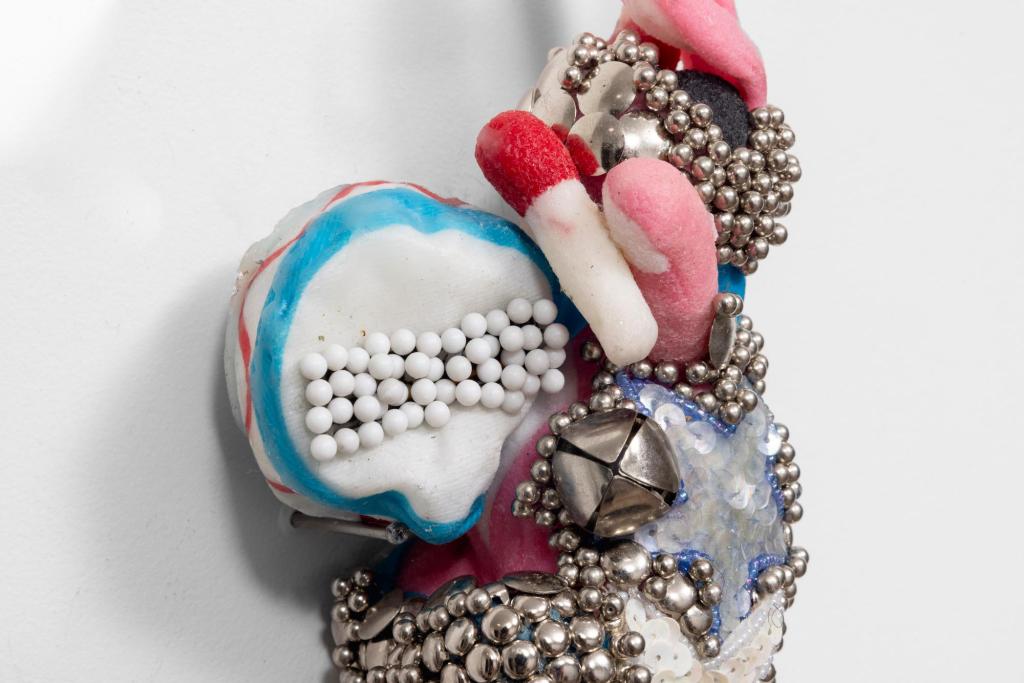
Cover image: Faith Icecold, Duck Season, 2026, Encaustic, sewing pins, clothing studs, thumb tacks, and sequined patches on Energizer Bunny™ plush coated in encaustic. Photo by Chris Uhren.
In Duck Season (2026), the pink ears of the Energizer Bunny are still recognizable beneath Faith Icecold’s additions of metallic pinheads and studs clustered around the toy’s face and body, while a sequined star and a bell competes with its drums. Wax coats the plush, changing the texture of an object made for softness. Sewing pins, clothing studs, and thumbtacks turn fastening hardware into ornament. The result is funny, lavish, and slightly alarming. A familiar advertising mascot has acquired an elaborate new appearance through a process that is both decorative and invasive.
The pins and studs that embellish the toy also puncture its soft exterior, introducing a subtle violence into an otherwise playful gesture. This tension between adornment and disruption runs through Cassandra, Icecold’s solo exhibition at Romance in Pittsburgh, on view from September 19 through October 31, 2026.
Across embellished textiles, wax-covered prints, narrow wall assemblages, and altered toy pianos, Icecold gives sustained attention to objects that might otherwise pass through our lives with little notice. A button, a souvenir, or a stuffed animal becomes meaningful through its placement and the work performed on it. These arrangements raise questions about how an object acquires value, who determines that value, and what forms of knowledge are already present in things routinely dismissed as decorative.
Born in New York in 1989 and based in Queens, Icecold has shown at venues that include Smart Objects in Los Angeles, HOUSING in New York, and take it easy in Atlanta, where they exhibited with Caleb Jamel Brown. In 2018, they received a Studio Immersion Project fellowship at the Robert Blackburn Printmaking Workshop. Their use of printed imagery is one part of a practice that repeatedly moves beyond the flat surface: pictures are coated, interrupted, bordered, and joined to objects.
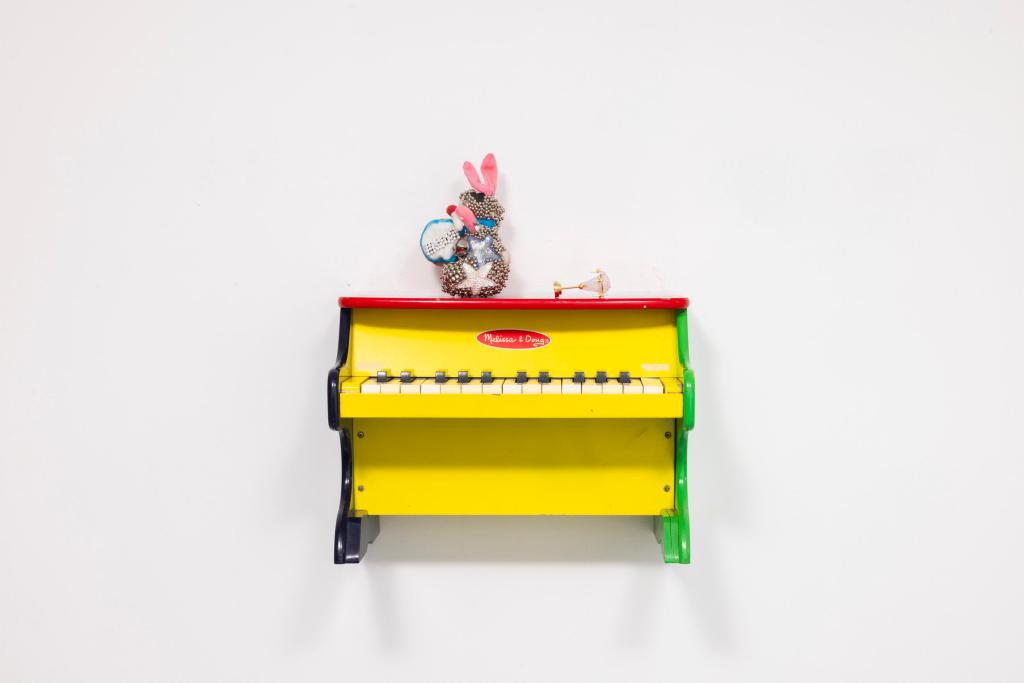
Act III, Scene I, 2026
Gift box bow, toy chandelier, adhesive, and vinyl on toy upright piano
Dimensions variable. Courtesy of Romance gallery. Photo by Chris Uhren.
Within the artist’s practice, the distinction between an image and the structure supporting it becomes increasingly difficult to maintain. Through the accumulation of beads, wax, coins, and found objects, Icecold transforms the picture plane into a physical environment in which the support becomes as visually consequential as the imagery it’s carrying. Materials traditionally viewed as embellishments or structural components become integral to the composition, challenging conventional distinctions between painting, sculpture, and decorative art. Icecold’s adopted name invokes Faith Ringgold, a connection that extends to their approaches to making. Ringgold’s work challenged the separation of painting from sewing, storytelling, and performance.
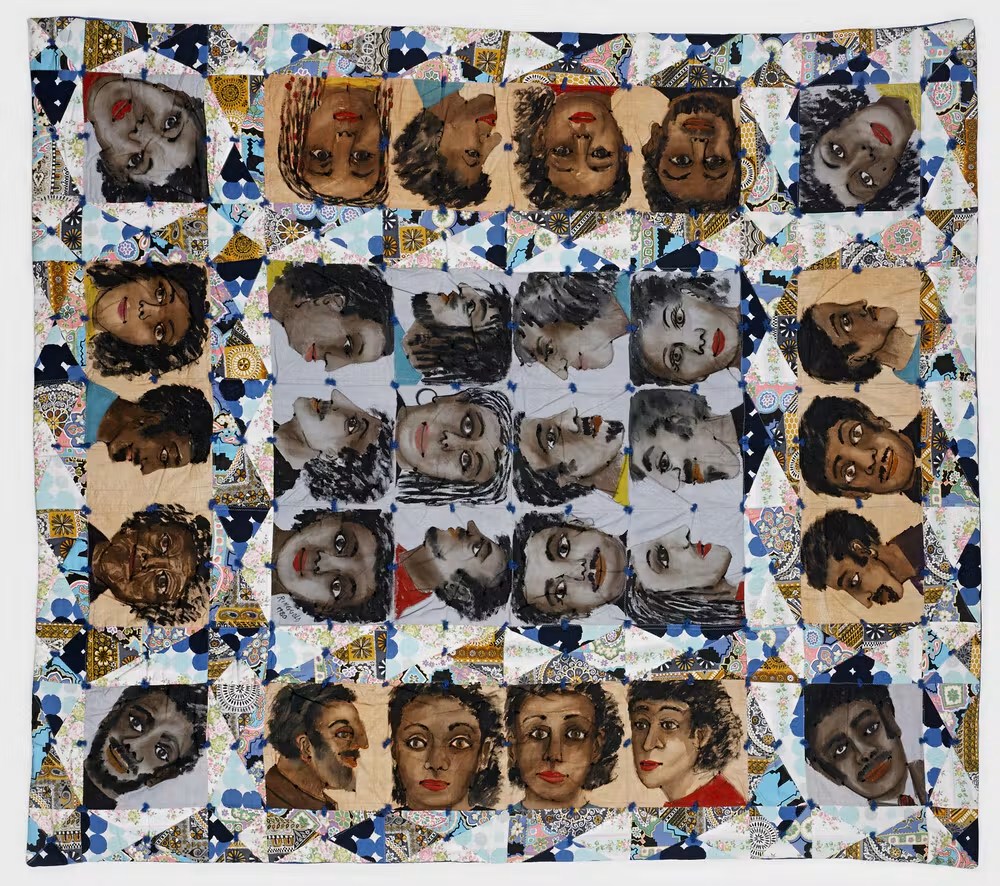
Echoes of Harlem, 1980
Hand-painted cotton
80 1/2 x 89 1/2 in. (204.5 x 227.3 cm)
(Photo: The Studio Museum in Harlem)
Her first quilt, Echoes of Harlem (1980), was made in collaboration with her mother, the fashion designer and seamstress Willi Posey. Its thirty painted faces appear within a composition organized through fabric and repetition. Ringgold’s subsequent story quilts gave Black lives and imagined histories an expansive pictorial form, while retaining the knowledge of construction that made those pictures possible. Ringgold’s masks, dolls, and larger stuffed figures make this relationship clearer. Her collaborations with Posey included fabric masks, while her dolls and larger stuffed figures also entered installations and performances. Fabric could depict a person, occupy space, and participate in an event. Icecold’s transformed plush animals and theatrical arrangements continue to test that mobility between image, object, and performance. The comparison extends beyond a shared use of textiles. Both practices make techniques associated with clothing, domestic production, and childhood central to ambitious artistic decisions.
In Antidote (2025), Icecold covers pink quilted silk with appliquéd motifs: a black horse, butterflies, flowers, stars, and musical notes. Their different scales and surfaces prevent the arrangement from being interpreted as a single scene. A horse can be read as an image, a patch, or an accessory. Sequins catch and reflect light as the viewer moves, producing subtle shifts across the textiles surface, while seams remain visible beneath the embellishment. Sewing is both a means of attachment and a way of composing relationships between otherwise unrelated images and objects. Through the placement of each element, Icecole creates a composition in which no single motif assumes greater importance than another.
Antidote directly references a quilt by Rosie Lee Tompkins, whose improvisational compositions challenged conventional distinctions between textile production and fine art. This connection situates Icecold’s work within a lineage of Black quiltmaking in which personal imagery and material experimentation become inseparable from making. The quilts of Gee’s Bend, Alabama, offer another point of comparison. Developed within families and communities whose histories extend through slavery, sharecropping, and civil rights, these works transformed clothing and fabric remnants into compositions of extraordinary formal invention. The Freedom Quilting Bee, founded in 1966 by quiltmakers from Gee’s Bend and neighboring communities, also made textile labor a basis for collective enterprise and employment.
Craft here concerns design, use, economic survival, and the transmission of expertise. It has never been adequately described by an account of style alone. Antidote differs substantially from the pieced geometries of Gee’s Bend quilts, but the comparison makes the significance of its construction clearer. Decisions about arrangement, repetition, joining, and surface belong to textile knowledge. Reading those decisions only through established categories of painting would obscure the expertise of makers whose work developed in homes and sewing rooms. Icecold’s use of ornament places pressure on the habits of judgment that allow a painted mark to signify invention while treating a stitched embellishment as an accessory.
Icecold’s Haitian heritage introduces another distinct history of adornment. In Haitian drapo Vodou, beads and sequins are used to make ceremonial flags that salute spirits and participate in ritual. Their reflective surfaces have religious and social purposes as well as visual effects. Haitian artist Myrlande Constant has expanded this tradition through monumental beaded compositions depicting Vodou spirits, Catholic saints, historical events, and everyday life. Her work emphasizes how much pictorial complexity and historical knowledge can be produced through the placement of small, repeated elements.
Although operating within distinct artistic contexts, Constant and Icecold share an investment in adornment as a means to command attention and invest a surface with significance. Icecold’s beadwork and embellished textiles similarly demonstrate how accumulated materials can transform a surface, although the objects in Cassandra should not automatically be assigned the ceremonial functions of drapo. In both practices, adornment moves beyond decoration to become integral to how an image is created, encountered and understood.
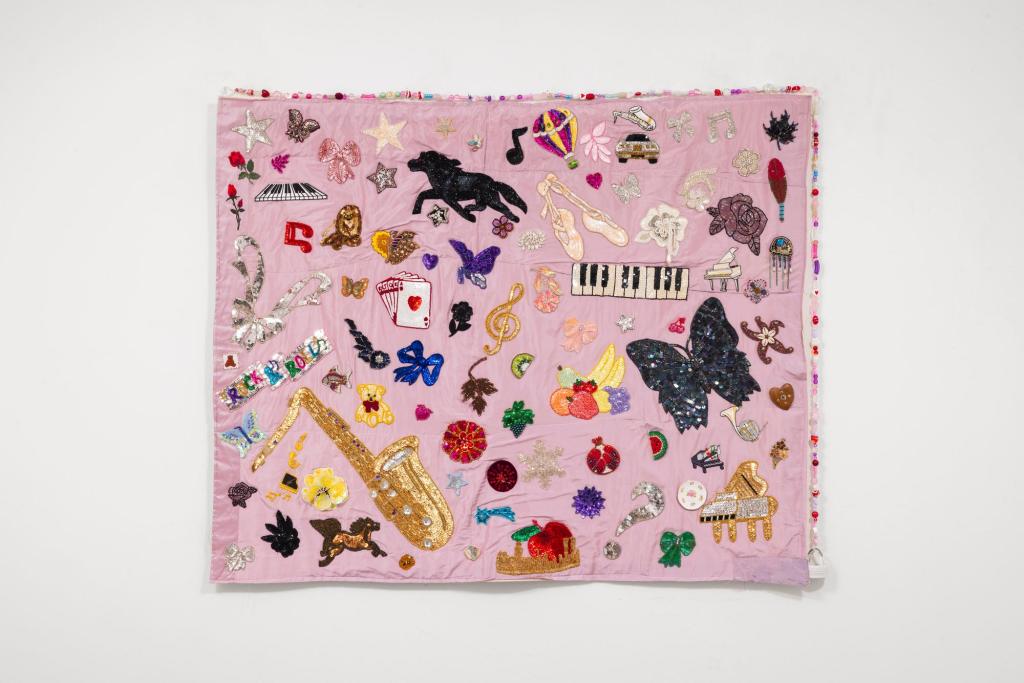
Antidote, 2025
Various beaded, embroidered, fabric, sequined appliqués, miniature ceramic plate, studded wood, glass button, and sun printing on quilted silk taffeta and canvas; glass beads, plastic beads, hardware and cornflower in ceramic basket. Photo by Chris Uhren.
In Cassandra, these considerations of adornment, cultural memory, and significance extend to commercially produced toys and contemporary printed imagery. Icecold’s materials move between devotional associations, personal attachment, and consumption without becoming interchangeable. The exhibition also belongs in conversation with Black assemblage, particularly the work of Betye Saar. In Black Girl’s Window (1969), Saar used a salvaged window frame to organize imagery associated with astrology, racial classification, family history, and the body. The frame gives these images a relationship without removing their differences.
Saar’s later The Liberation of Aunt Jemima (1972) transformed a racist commercial figure into an armed protagonist. Through selection and recombination, Saar changed what a familiar object could say and who could determine its meaning. Icecold’s treatment of a branded toy in Duck Season raises a related question about the authority of manufactured images, although its subject and politics differ from Saar’s intervention. The original object is still legible beneath the artist’s work. Its recognition is necessary to the joke, but recognition does not exhaust its meaning. Likewise, the cowrie shells, buttons, bells, and miniature furnishings in Icecold’s wall assemblages retain associations with dress, exchange, sound, and domestic life. Their new arrangements require the viewer to account for several kinds of familiarity at once.
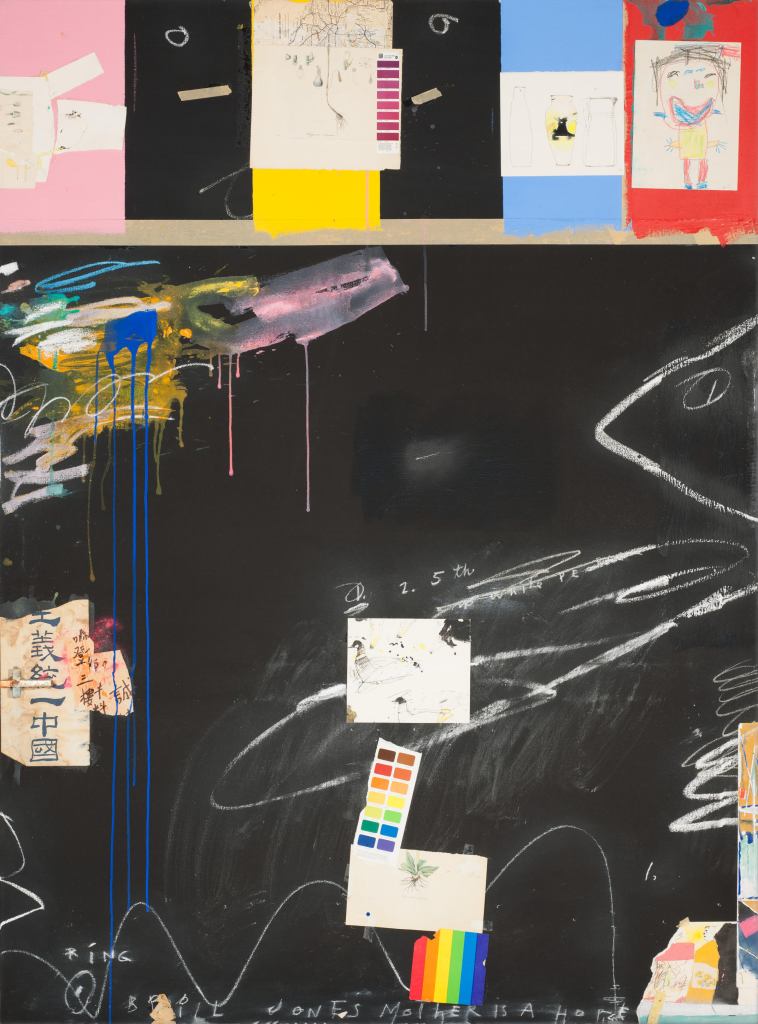
Layers of Being ,1985
Mixed Media on Canvas
81 × 59 15/16 × 1 in205.74 × 152.24 × 2.54 cm
(Photo: Carnegie Museum of Art)
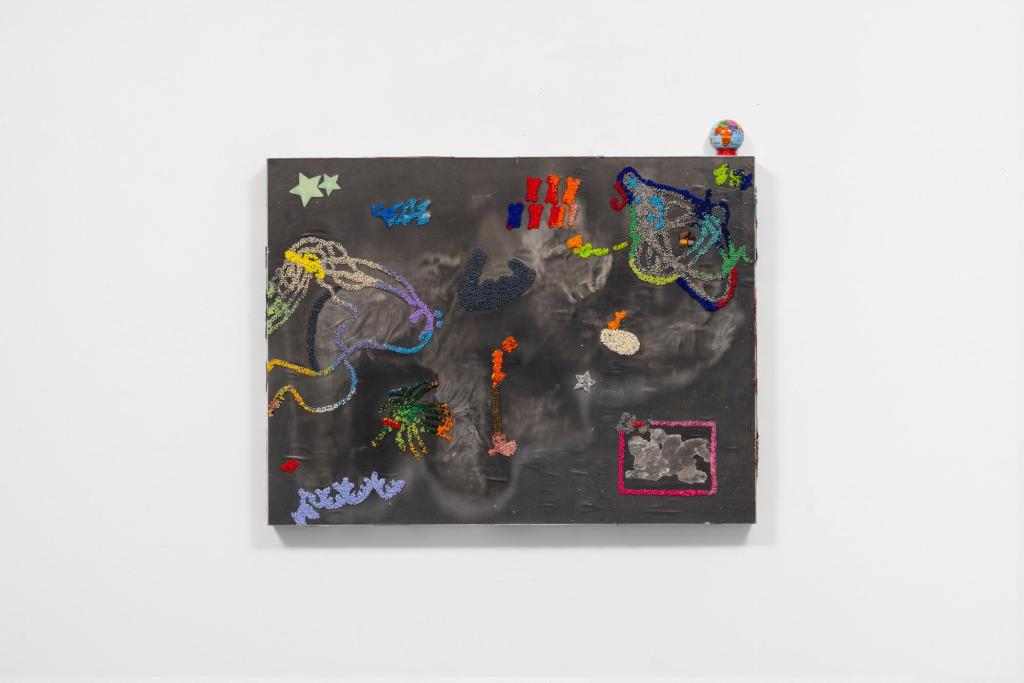
Address Me, 2026
Encaustic, glass seed beards, glow-in-the-dark stars, and sequined star embroidered patch on inkjet print on paper mounted to wood board; encaustic on inkjet prints, various trim, rhinestones, snakeskin, thumb tacks, drawings from artist’s archive, miniature globe
1812 × 2412 in. (47 × 62.2 cm). Photo by Chris Uhren.
Address Me (2026) recalls Raymond Saunders’s use of black grounds, drawing, writing, and objects gathered from his surroundings. Saunders’s compositions allow different forms of notation and material evidence to coexist without reducing them to a uniform pictorial language. In Address Me, colored beads, stars, patches, and other additions interrupt a dark wax-covered surface. The treatment continues onto the sides, where thumbtacks and rhinestones contribute to the composition. Turning toward the work’s edge produces further detail to encounter. The frame and support participate in the image rather than simply defining its limits. That expansion of the painting’s structure also invites a comparison with Jack Whitten.
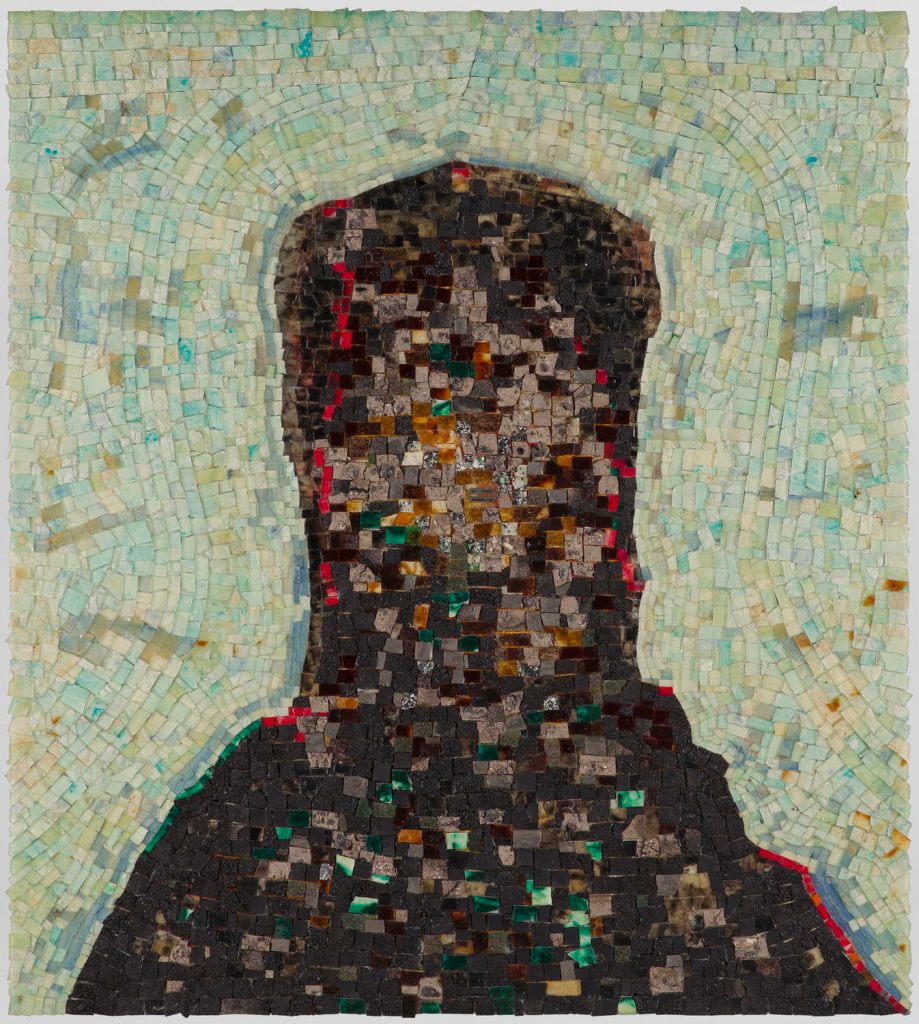
Black Monolith II, Homage To Ralph Ellison The Invisible Man, 1994
Acrylic, molasses, copper, salt, coal, ash, chocolate, onion, herbs, rust, eggshell, razor blade on canvas, 58 1/2 × 52 1/2 × 1 3/4 in. (148.6 × 133.4 × 4.4 cm).
(Photo: Brooklyn Museum)
Icecold credits much of their technical education to Boyce Cummings, an instructor at the Art Students League who, according to the artist, worked closely with Whitten during the development of his mosaic-like paintings. Developed in the 1990s, the paintings were created by cutting dried acrylic into tiles and assembling them on canvas. Whitten’s Black Monolith works memorialized influential Black figures through surfaces built from many individual units. Icecold’s mosaics operate differently, incorporating recognizable objects rather than relying primarily on manufactured paint fragments. Both artists construct their surfaces piece by piece, and in both practices, the act of assembly becomes inseparable from the image itself.
In Icecold’s Chorus Chanting and Distant Sound Effects, both made in 2026, mortar and grout secure objects within narrow vertical structures. Bells, buttons, shells, and miniatures create abrupt changes in scale and texture. A miniature piano or table suggests an interior, but the surrounding objects prevent it from becoming a coherent model room. These assemblages continually shift between something architectural and something intimate. Their titles introduce sound into works whose most immediate activity is visual – a bell suggests the possibility of ringing even when embedded in a construction; an instrument can imply music without producing it. The altered toy pianos extend that interest into performance. In Act I, Scene I (2026), feathers spread across the keyboard of a wooden upright piano. Act V, Scene V (2026) incorporates miniature microphones, while Act III, Scene I (2026) includes a toy chandelier.
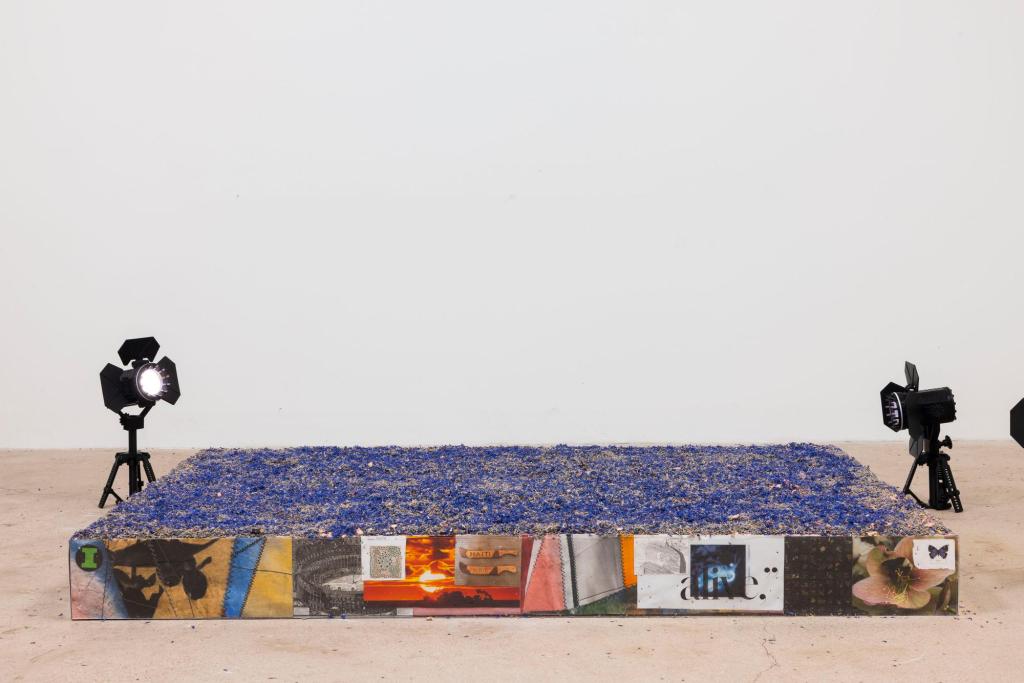
Six Degrees of Separation, 2026
Dried cornflower and dried lavender, silk taffeta, canvas, acrylic, collaged imagery and found materials on wood; miniature stage lighting. Photo by Chris Uhren.
These additions introduce the equipment and furnishings of a performance at a scale associated with play. The act-and-scene titles suggest episodes in a drama, but the objects do not offer a complete script. They leave the viewer considering who might perform, what might be heard, and whether the arrangement is an invitation, or the aftermath of an event. Six Degrees of Separation (2026) makes the question of display particularly explicit. A low rectangular platform covered with dried cornflower and lavender is surrounded by miniature stage lights. Along its sides, collaged images interrupt the flower-covered field above. The arrangement brings the austerity of a simple geometric form into contact with plant matter and theatrical equipment. Its presentation suggests that attention can be constructed: something close to the floor, modest in height, becomes a spectacle through lighting, placement, and the density of its surface.
The title Cassandra introduces a question about the reception of knowledge. In Greek mythology, Cassandra possesses the ability to foresee events but is condemned not to be believed. In relation to Icecold’s exhibition, that story invites a reading concerned with credibility: what allows a statement, a person, or an object to be taken seriously? The history of Black craft and assemblage gives this question particular force. Expertise has often been present in objects long before institutions have granted their makers recognition.
The delay belongs to the structures of recognition, rather than to the invention itself. Cassandra’s materials make that issue visible without resolving every object into a symbol. A sequined patch can remain playful; a toy can remain ridiculous. Those qualities are part of how the works address the viewer. Icecold’s repeated acts of stitching, coating, embedding, and rearranging give familiar things a new demand on our attention. In Duck Season, the bunny’s pink ears survive above a face almost overtaken by metallic ornament. The bunny remains recognizable, but its transformation asks for a sustained look at what has been done to it, and at the labor that made its new appearance possible.
Tara Fay Coleman is an artist, independent curator, writer, and cultural worker from Buffalo, NY. Her practice aims to explore how power, race, and history shape what is seen, and what is systematically obscured. Working across art, writing, and curation, she centers Black cultural production that resists dominant narratives, and reclaims the right to self-representation. Rooted in lived experience, her work aims to challenge institutions to confront their exclusions, while creating space for stories long marginalized. Her goal is to always curate with a commitment to presence, complexity, and care, and she envisions cultural spaces where artists are not only visible, but central, and where art fosters joy, connection, and self-determination.
Cassandra is on view from September 19 through October 31 at Romance Gallery (155 N Craig St).
Order Petrichor’s very first print issue or subscribe for four issues a year.
Sponsored by the Pittsburgh Opera, Kelly Strayhorn Theatre, and the Pittsburgh Vintage Mixer.




Leave a Reply