Interview by Rich Pell
The Center for PostNatural History is the world’s only museum focusing specifically on living things that have been domesticated, bred, or engineered by humans. And we’ve been open in the Garfield neighborhood of Pittsburgh, PA since 2012. Each year we open our collection to a different artist to interpret or use in their artwork as they see fit. For the last year that artist has been the extraordinary Celeste Neuhaus. Celeste’s performance this Friday November 20th, will mark the end of a year-long cycle of performances entitled In Observance. Tickets may be purchased here. This interview between Rich Pell, founder and director of the Center for PostNatural History, and Celeste Neuhaus, the 2026 PostNatural Artist-in-Residence was conducted at the museum on November 12, 2026.
Rich Pell: Celeste, you’ve been the Postnatural artist in residence for the year 2026. During that time you developed a cycle of performances concerning the cosmological roots of American holidays. Is that something that’s been in your work for a long time?
Celeste Neuhaus: It has. Holidays are inherently cosmological in the sense that they mark these turning points of seasons and these sort of energetic shifts, and they occur because of the Earth’s orbit and the Earth’s axis. And so they have these relationships to lightness and darkness, to growth and decay. And holidays have this stratification where they have all of these roots originating in the shifts of the seasons, deities and mythologies that they draw from. And then they have these iterations that happen over time that we’re experiencing on this surface level now with each one. I’ve been working with the byproducts of consumption with holidays for quite some time. The mass produced plastic artifacts of the celebration, of the ritual, as a sort of a gateway or portal into the true essence of the celebration. Plastic jack-o-lanterns or fake Christmas trees, this synthetic version of nature that stands in for the natural world. And to bring attention to the abstraction of the natural world and the ways in which we engage with the synthetic versions of it as though they are the actual thing.
“Holidays are inherently cosmological in the sense that they mark these turning points of seasons and these sort of energetic shifts, and they occur because of the Earth’s orbit and the Earth’s axis. And so they have these relationships to lightness and darkness, to growth and decay.”
RP: Do you see these plastic commodified versions of ritual objects as still a part of the same ritual, or is it just kind of what’s left over?
CN: If you take plastic Easter eggs as an example, we use those a lot in “Hatching The Plot”. That was a reclamation of Easter combined with May Day and Beltane. It’s this cosmic egg, the symbol of the origin of life or creation. It’s used in alchemy. It’s used in the Gnostic gospels. You see themes of the cosmic egg all around the world and different cosmologies. To me it’s yet another manifestation of this impulse to celebrate life. It’s just a surrogate. I’m not using it necessarily as a condemnation. There’s a lot of joy there. Many of us have nostalgic associations with Easter egg hunts and plastic eggs that have candy inside. So it’s to celebrate that we have this impulse, but also to reconnect that impulse to something more essential, more elemental, and not just be left with the purely rote ritual of consumption.
RP: You had a Fourth of July performance, and you have a Thanksgiving performance coming up. Both of those have kind of heavy nationalistic and colonial baggage with them, which I know is part of the attraction. How are you negotiating this as a reclamation? You’ve used that word a few times.
CN: “Mothering The Exile” was the Fourth of July reclamation. So one example is, that that title comes from the poem that is on the plaque at the base of the Statue of Liberty. The poem celebrates giving mercy and shelter and nurturing people coming to this country who need care. I use that to highlight the difference between what the actual treatment of immigrants in this country has been and has been recently. I bring together the interiority of the psychological with how it is in a dialectical relationship with what we experience in the political landscape. That performance was about giving love and care and nurturing and devotion to that within us and for generations perhaps has been exiled, or relegated to the shadow.
RP: Your performances involve a certain amount of audience participation. Were there any reactions that surprised you or did people resist?
CN: I’m often surprised that people are so willing to participate. I do my best to create the conditions that encourage safety and trust and the ability to be vulnerable. And part of that is that I’m making myself so vulnerable. I’m often surprised at the level of vulnerability that people are willing to access. I also intend for there to be a playfulness. And so people’s willingness to play is always a fun and unexpected part of the interactivity. I guess one real surprise was during “Mothering The Exile” when we were playing “light as a feather, stiff as a board” with a taxidermy canary from your collection, as a stand in for “canary in the coal mine”. The first group lifted the stretcher that I had the canary on, as high as they could possibly reach. I was worried, I didn’t want to damage the canary specimen. And then the second group, when they were doing their version of “light as a feather, stiff as a board”, they didn’t lift the stretcher more than like an inch or so off of the ground. And so there’s the exuberance that one group can have, and another group can take the same prompt in a totally different direction.
RP: Talk us through the cycle of performance in In Observance.
CN: The first performance was “Licking The Wound”, and that dealt with themes of wildness and domestication and also citizenship. My friend who was supposed to perform with me, was unable to attend because they are an immigrant and it wasn’t safe for them to navigate airports. So we worked that into the piece. There was genuine wounding and fear and pain that was being lovingly and sometimes erotically held in that performance. But it felt like that was reaching deep into our collective woundedness, in a way. The next performance was “Hatching The Plot.” It was this cosmological understanding of creation, but it was also this birth. So it went from erotically touching this wound to experiencing this rebirth. The third performance was “Mothering The Exile” which involved singing lullabies to a taxidermied rat that had been selectively bred to be an alcoholic, and reading fairy tales to a mockingbird specimen. So there were these acts of mothering.
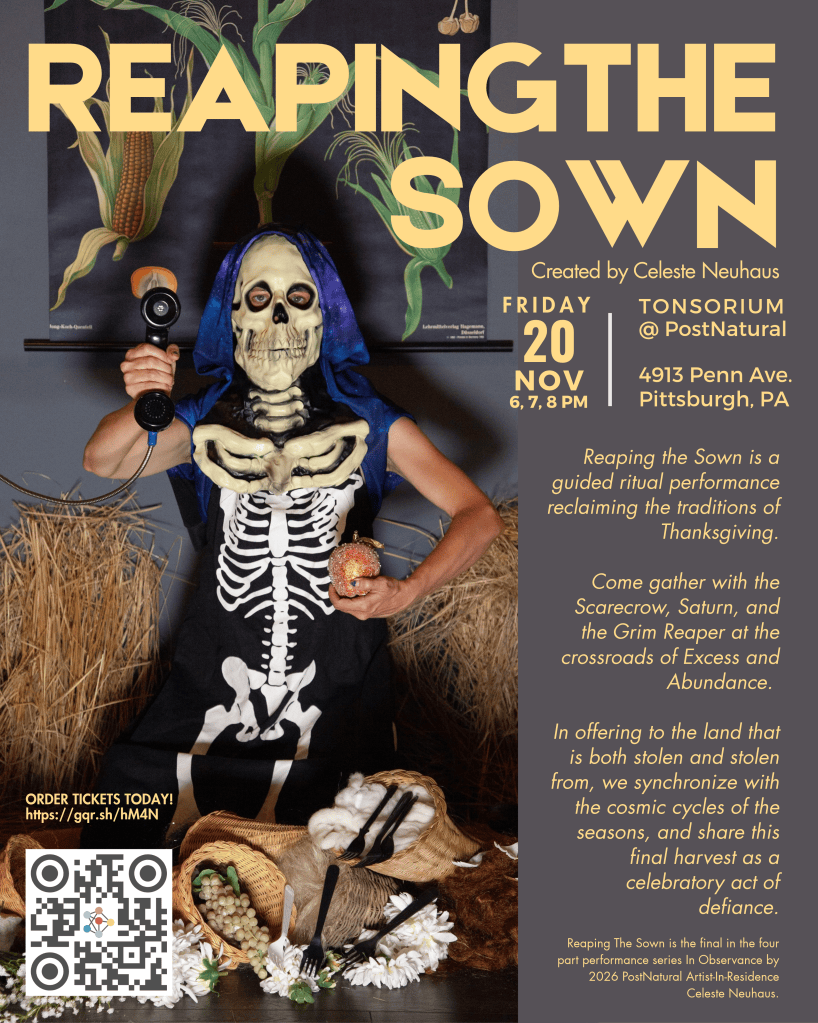
RP: Your upcoming piece, the Thanksgiving piece, “Reaping The Sown”, is happening Friday, November 20th. What can you tell us about it and how does it close the In Observance cycle?
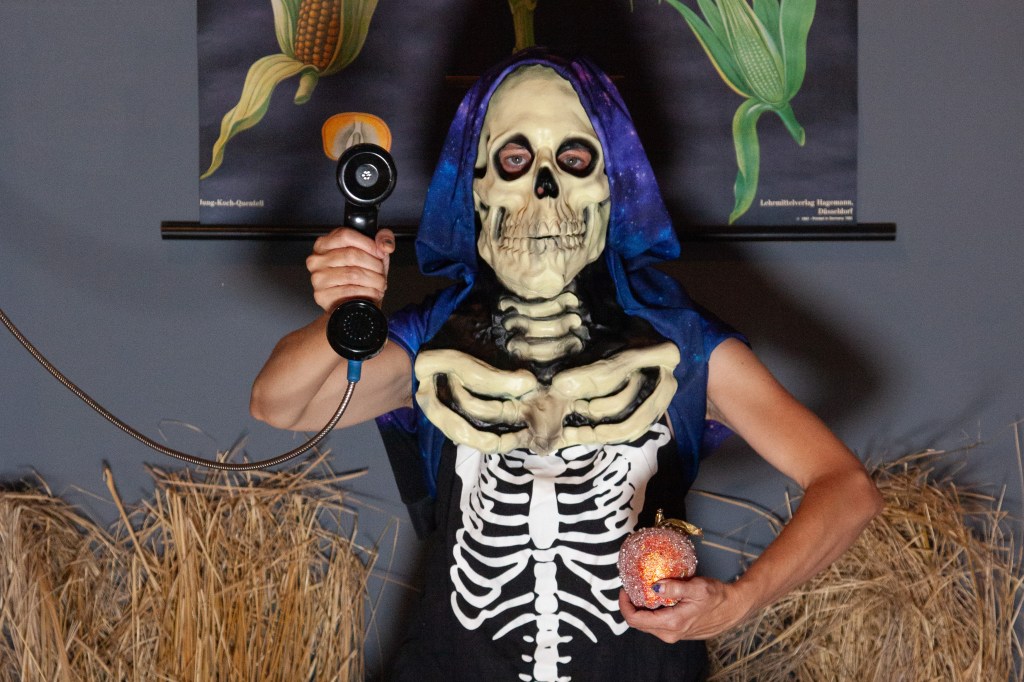
This upcoming performance is “Reaping The Sown”, which is bringing in this agrarian, harvest festival that has connections with Chronos as the Reaper and Father Time. It’s bringing in the father element of the parenting process. But also the death within harvesting and the life that that harvesting is able to generate. This cycle of the holiday themed performances through the year, follow these themes of death and rebirth and how they become one another.
“This cycle of the holiday themed performances through the year, follow these themes of death and rebirth and how they become one another.”
RP: What, if anything, do you think you will carry forward from this residency into the next project or chapter?
CN: Well, so much research goes into each of these performances and so much experimentation. There’s a lot of risk taking and a lot of improvisation. These were specifically tailored to this context and interwoven with this collection and that lent a real specific tone and flavor to each of them. So, I’d like to offer versions of these rituals that are specific to other environments, and to take pieces of each and offer them again. I’d be curious to see what happens when I offer them in a different city or a different environment.
RP: Is there anything else you’d like to add or plug?
CN: I’m currently a National Artist in Residence at Contemporary Craft. Between now and this next performance,”Reaping the Sown” I’ll be working on weaving some cornucopias out of fiber optic cable for the props that I will be including.
I taught a workshop here called “The Erotics Of Air” as part of a series of workshops I am offering through the healing work I do called Conjure Creativity, where I help people align with their creative process. I’ve been leading workshops with each of the elements: fire, earth, air, water and aether to help people connect with that elemental force and how it interacts with their creative process. You can find out more at https://www.celesteneuhaus.com/ or on Instagram: https://www.instagram.com/conjure_creativity/
Celeste Neuhaus (she/they) is a multimodal artist and witch who constellates magic, ecology, and healing. Through sculpture, painting, assemblage, installation and guided rituals, their art incites transformation by reckoning with the disconnections caused by living within amalgamated systems of necrocapitalism and corresponding biodiversity annihilation. Incorporating alchemy, surrealism, the absurd and the erotic, her work vividly materializes the often subconscious interdependencies in the continuum between the somatic – psychological – political – ecological – cosmological – metaphysical.
Since 2008, the Center for PostNatural History has played a vital role in increasing understanding of human entanglement with the natural world. While humans were once mere participants in the evolutionary process, we are now a primary force shaping it, from the indigenous origins of agriculture to genetic engineering. Such profound transformation necessitates public education, awareness, and dialogue, which PostNatural provides through exhibitions, workshops, collaborations, and multimedia content.
Order Petrichor’s summer and fall print issues or subscribe for four issues a year



Leave a Reply