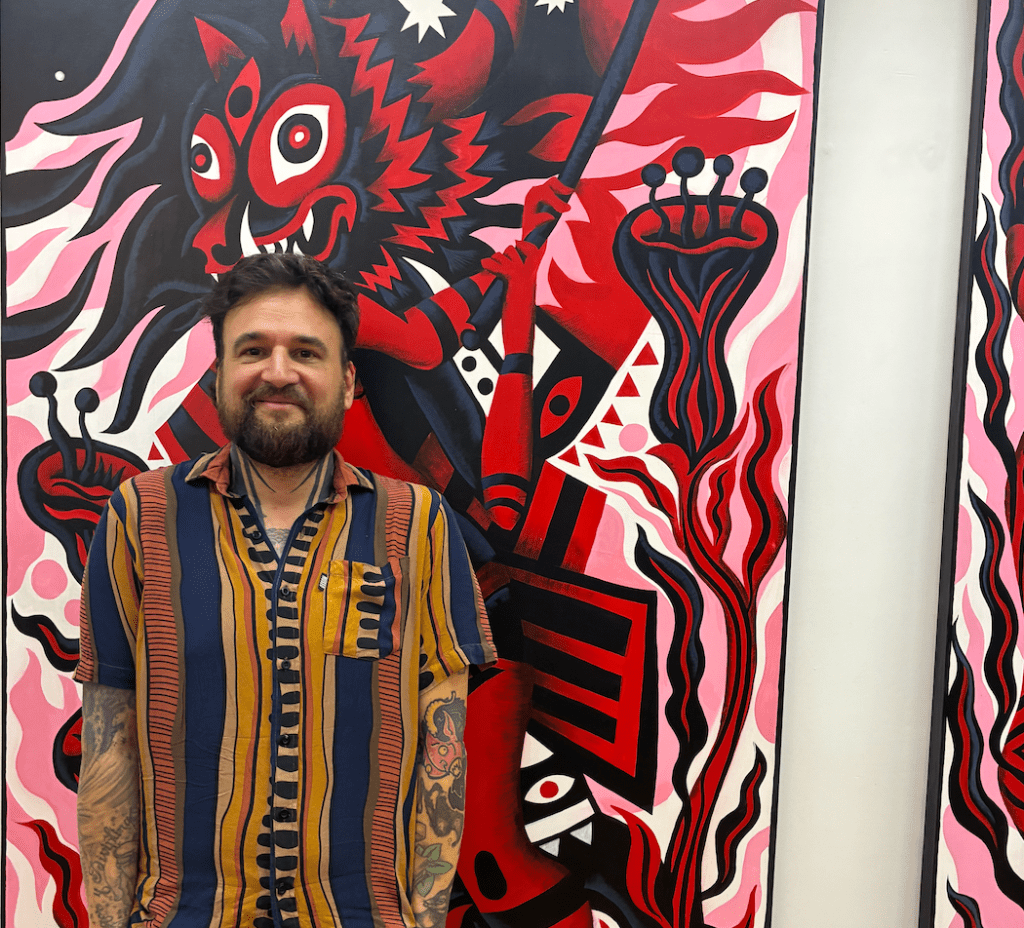
by Emma Riva
By now, it’s trite to call something “trippy.” Many people use the word as a stand in for something then don’t understand, as if someone would have to be on drugs to have created something unsettling or absurd. And not everything described that way has the transformative quality images from psychedelics have. But Tomas Ives’ paintings do have that quality—the undulating specters that feel both past and future, reverie and suffering.
Ives, originally from Chile, is staying in Pittsburgh through the fall to participate in a mural and printmaking residency, but kicked it off with Interscapes at Atithi Studios on August 22. The title draws from Chilean surrealist Roberto Matta, who coined the term “inscapes” to discuss works of art as the interior landscape of an artist’s mind. Though Ives’ work is not necessarily surrealist, it has the surrealist’s ability to compress time and space. Are you looking at a painting of something from the ancient past or something from the unknowable future? Dalí executed this principle literally with melting clocks. Ives does it by blending figures from different mythologies, including the Aztec, Greek, and Roman traditions.
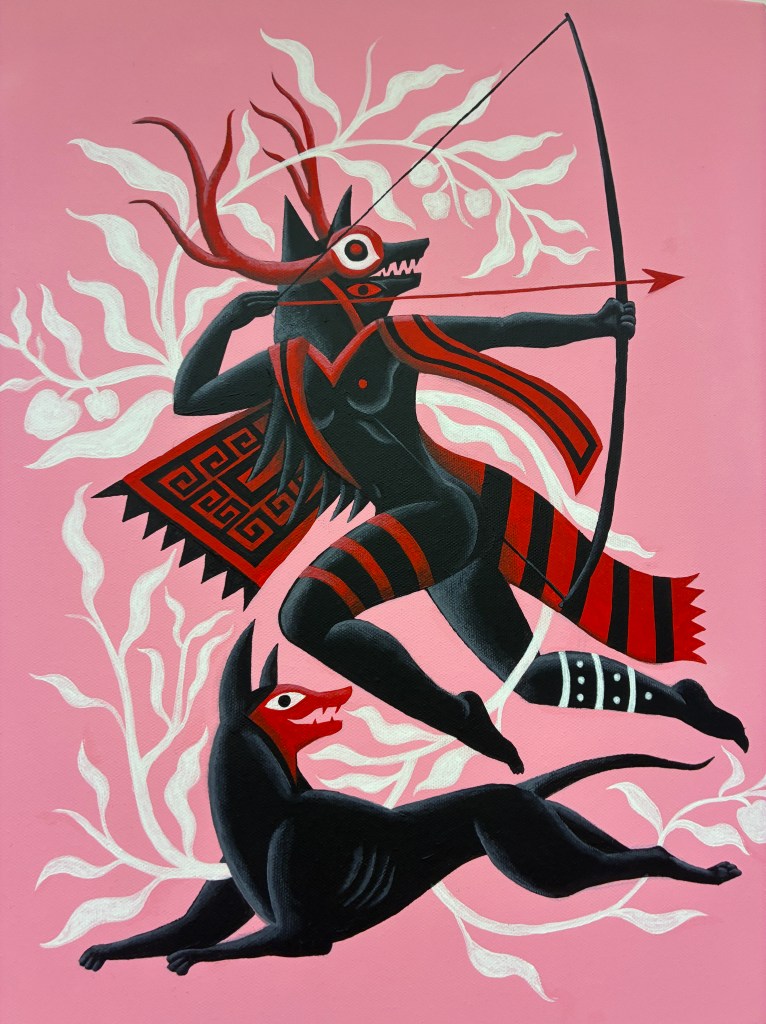
A standout work is Diana, where a nude huntress figure with the head of a wolf leaps in the air, accompanied by a lean jackal. Red antlers sprout from between her ears. The wolf is a central figure for Ives, maybe because it represents the line between the domestic and the wild. All of our bred dogs descend from wolves, just as each of us descends from wilder, less technologically advanced versions of human life. But just as a dog and a wolf don’t look so different from each other, Ives’ work invites us to see how our fears and desires are not so different than the ancient gods and goddesses.
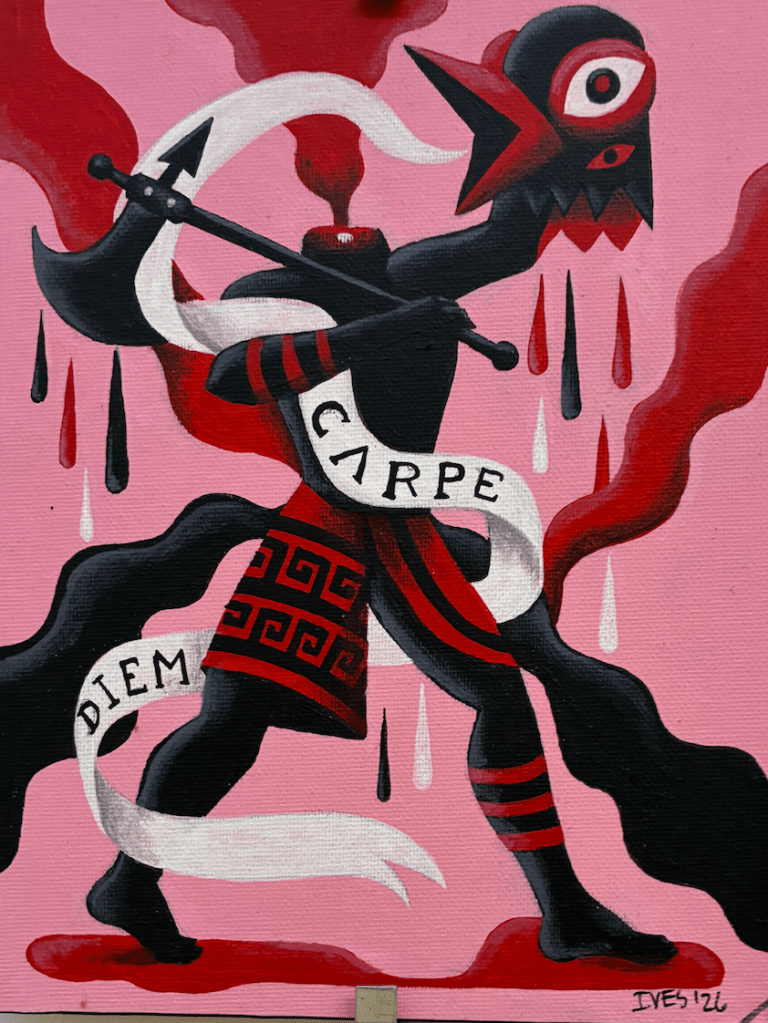
In Carpe, a birdlike figure holds his own decapitated head while a sash saying Carpe Diem drapes around his body. Ives describes this work as “sarcastic,” and there is a wider political implication to the image of somebody who is already dead telling you to live in the moment. Images from Greece, Rome, and Tenochtitlan show us that the political world we live in now is not new, and that our mistake may have been allowing Pax Americana and technological advancement to fool us into believing it was.
Figures from mythology are frequently co-opted by conservative thinkers to represent strength and virtue, but the classical world has much to teach all of us about power and violence. Ives’ paintings were stuck in a U.S. customs holding facility in Miami, delaying the opening, and it’s somewhat amusing to imagine customs officers trying to figure out what to make of work that has little regard for modern borders. I spoke with Ives earlier in the summer about what to expect from his show, thinking it would be on the 6th, but by the 22nd the paintings had been reclaimed and could be displayed. I wonder what the customs officers made of them.
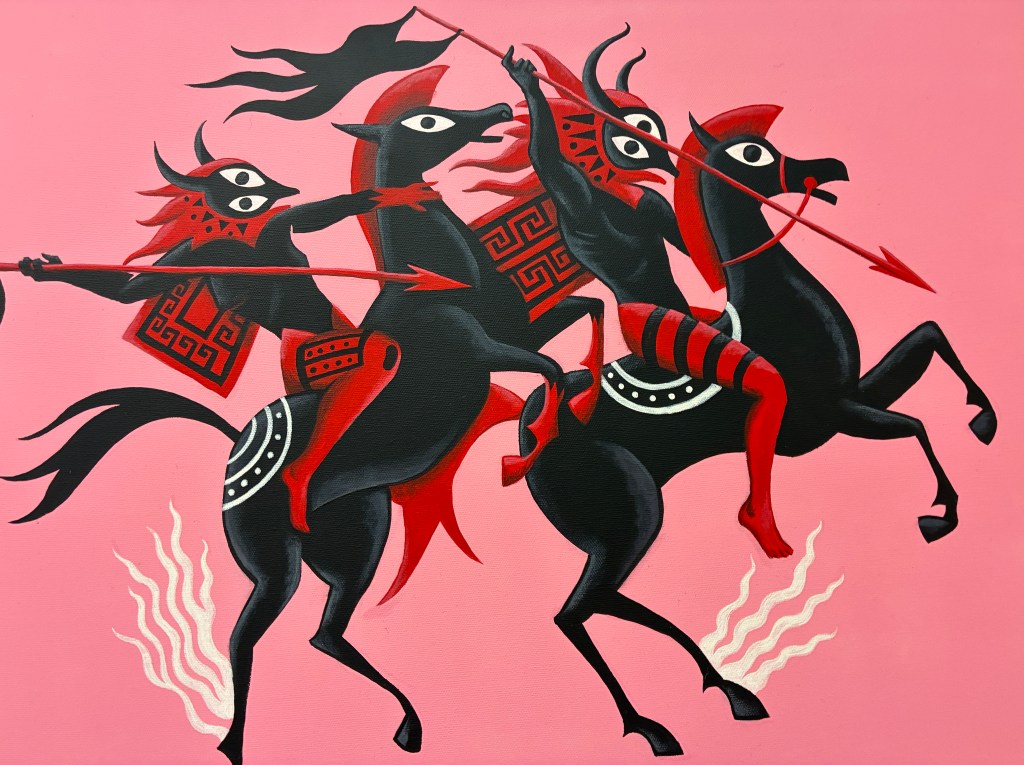
In his technique, Ives has the ability to be both consistent and surprising. His skill as a printmaker comes through in how the figures and the background feel distinct, as if the images are tattooed onto the background. The figuration and color scheme are so strikingly similar in each painting that it feels like Ives must have done some sort of magic to achieve it. The only change the exhibition might benefit from is seeing the paintings in a differently laid out space. While Atithi is a beautiful venue, I would be interested to see how they would look in a more intimate space with lower lighting. But the space allows for a sense of scale that the paintings draw from, especially in the big diptych in the centerpiece.
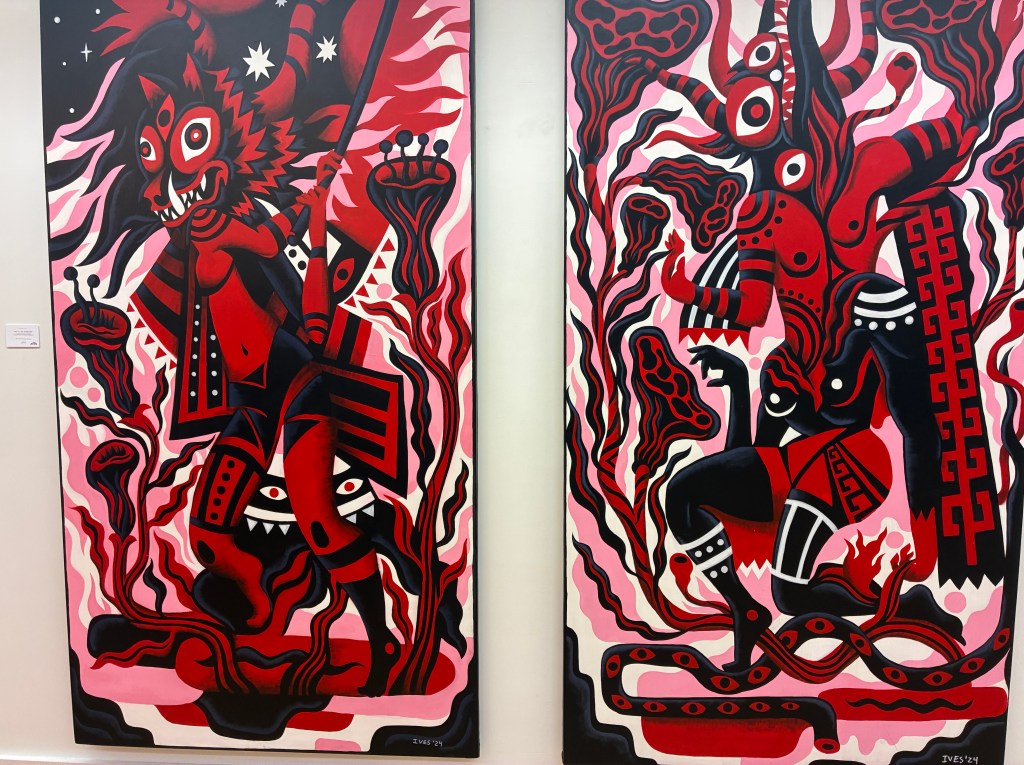
I had returned from transatlantic travel the night before seeing the show at 1AM, and so I felt the plasticity of time in Ives’ work in an acute way. By blending human beings and wild boars and different cultures’ mythologies on a flat plane of colors with little shading, Ives shows how difference is illusory.
I woke up at 7AM in Rome and landed in Pittsburgh at 12AM, but I had been up for 24 hours. There’s nothing like time zones to make everything around you feel fake. Ives’ work, however, does not take the postmodern approach of nothing being real and everything needing to be dismantled. To him, everything is real, and who’s to say it’s not dismantled already?
Emma Riva is the founder of Petrichor.
Order Petrichor’s very first print issue or subscribe for four issues a year.
Note: Petrichor will be going on a brief break in August to recoup and recharge! Thank you for your continued support and welcome to all new subscribers. Also thank you to our sponsor, Pittsburgh Opera.

 PETRICHOR
Leave a comment